Boulder City Council driven by fear

Op-ed originally printed in the Boulder Daily Camera on 12/16/2018.

Several times in recent months, the Boulder City Council has proposed far-reaching building moratoriums with little evidence of need and with very little public process.

A moratorium on building large homes on residential lots. A moratorium on building new housing in business zones after a rumored redevelopment of the partly-empty Base-Mar Shopping Center. A moratorium on redevelopment of an “opportunity zone” that includes the long-distressed Diagonal Plaza.

Rather than setting a vision for local policy to help Boulder adjust to change and economic conditions, the City Council’s actions show a reactive group that fears a changing city.

After scheduling an emergency vote to limit large houses in Boulder, City Council backed off from its original proposal after significant community pushback. The measure would have disallowed new homes greater than 3,500 square feet, without any plan to address the root problems of large homes or affordable housing shortages in Boulder’s neighborhoods. Rather, our city leaders need to bring proactive ideas to address our problems. For instance, council members Jill Adler Grano and Bob Yates countered with a proposal to require large homes to contribute to Boulder’s affordable housing fund.

The newly-updated accessory dwelling unit ordinance should be used as a tool to create incentives for smaller homes affordable to a wider range of potential owners in our community. We should allow homeowners with larger lots to split the lot and build a smaller, additional home. Council should embrace ideas like duplexes and triplexes, which are not legal in most of Boulder’s residential areas, to serve younger families or older couples wishing to downsize and still afford to live in town. The fear of change in our neighborhoods drives a policy that doesn’t plan for a future of diverse housing needs.

On Tuesday, City Council will consider an updated proposal for changes to business zoning districts that would have banned any use of housing on first-floor properties. As the Camera reported, the proposal was “brought forward by city councilwomen Cindy Carlisle and Mirabai Nagle, who were concerned about the possibility of student housing being built at Base-Mar Shopping Center.” The moratorium was a reaction to make a particular project unviable rather than proactively planning for change that the neighborhood and city might want. We could take the opportunity to create more 15-minute neighborhoods and a better bikeable and walkable community, and establish permanently affordable retail space. Instead, members of City Council moved to preserve still-vacant buildings occupied just 12 months ago by Whole Foods, The Egg & I, Everyone’s Hair, and Beau Jo’s Pizza. While the new proposal has since become less extreme, the council still lacks a vision to move our city forward in a rapidly changing retail environment. The fear of change in neighborhood retail drives a policy that clings onto shopping centers that no longer meet the needs of the community.

City Council will also make policy regulating the opportunity zone, a status meant to encourage investment in lower-income areas. Boulder applied for an opportunity zone that includes Diagonal Plaza, a strip mall in serious disrepair. City Council pushed to halt possible redevelopment. From Councilman Sam Weaver’s council Hotline email, he proposes a development moratorium until “each zone district in the OZ has been reviewed under the current Use Table Review project” and no office space be allowed until “a sub-community plan is in place.” If you have visited Diagonal Plaza recently, you may agree it is an area in great need of redevelopment. The massive, empty parking lot along with a number of vacant businesses could serve as a terrific place for a mix of housing, retail and office space, creating a modern walkable community. The North Boulder Subcommunity Plan took 10 years to complete — how long must our city wait to make progress on desperately needed priorities outlined in the Comprehensive Plan? Instead, council members criticized the city manager for accepting opportunity zone status which would bring federal subsidies into Boulder — a move that is in the best interest of the city. The fear that tax incentives will aid redevelopment drives Council to tighten regulations and resist needed change.

Our city government has enormous control over the way that Boulder will change over the long-term. We need a council that will be looking forward instead of fighting change that is inevitable.

Eric Budd is a former candidate for City Council and former chair of the Boulder Landmarks Board. He is a current member of the Better Boulder Executive Committee. Twitter: @ericmbudd.

How I’m voting in the 2018 Colorado Elections

Colorado’s 2018 ballot includes a number of statewide offices and ballot measures that intend to address the state’s population and economic growth, education funding, and the balance of local land/safety with oil and gas interests.

Colorado’s statewide offices are largely controlled by Republicans, which could change significantly with a number of strong Democratic challengers. The state legislature currently is split (rare among the 50 US states) between a slight Democratic majority in the House and a slight Republican majority in the Senate.

While much of the election’s focus has been on national politics, 2018’s results will largely determine Colorado’s direction for the next four to eight years and adds more reason to make ensure you (and your friends!) vote.

Federal Offices

Representative to the 116th United States Congress – District 2  — Joe NeguseDemocratic

I’ve written about Joe Neguse: “Joe is incredibly bright, engaging, and will fight to protect the environment in Colorado. As a son of Eritrean immigrants, I could not be prouder to have Joe represent me at a time when immigrants should be valued, celebrated.” As Joe said at a recent campaign event, “I’m running for congress because that dream—the American dream—is under attack like it has never been in my lifetime.” I completely agree.

While some have attacked Joe as not being progressive enough for various reasons, I’ve seen in Joe’s work and experience that he will work hard to represent progressive values we have in Boulder and Colorado.

State Offices

Governor/Lieutenant Governor — Jared Polis / Dianne PrimaveraDemocratic
Secretary of State — Jena GriswoldDemocratic
State Treasurer — Dave YoungDemocratic
Attorney General — Phil WeiserDemocratic
State Board of Education Member – Congressional District 2 — Angelika SchroederDemocratic
Regent of the University of Colorado – At Large — Lesley Smith – Democratic
State Representative – District 13 — K.C. Becker – Democratic

I’m voting for Democrats all the way down the ballot. I’ll give a few key points about some of the candidates and what’s at stake. I’m voting for Jared Polis for governor because he’s going to push our state in a progressive direction on clean energy and I hope to ensure our state grows in an equitable way with opportunity for all people. I think Jared’s business background is a positive overall, but would like him to have supported more progressive ballot measures this year (prop 73 for increasing education funding and prop 112 for safer setbacks from fracking). It’s clear that progressives in Colorado will need to keep pushing our elected leaders when they take moderate or conservative positions as many have this election cycle.

For other statewide offices, I’m voting Jena Griswold for secretary of state as we need to continue to push to remove barriers to participation for voters in Colorado, including a push for automatic voter registration. I’m supporting Phil Weiser for attorney general as someone who will push back on the overreach from the Trump administration. I’m supporting Lesley Smith for CU Regent because the board’s current conservative majority has been pushing its regressive ideology onto CU system, and as someone who considers Lesley a friend personally, I could not think of a person with better experience and progressive values to bring a thoughtful, practical direction to the university board.

Local Offices

District Attorney – 20th Judicial District — Michael Dougherty – Democratic
Regional Transportation District Director – District O — Lynn Guissinger
County Offices County Commissioner – District 3 — Matt Jones – Democratic
County Clerk and Recorder — Molly Fitzpatrick – Democratic
County Treasurer — Paul Weissmann – Democratic
County Assessor — Cynthia Braddock – Democratic
County Sheriff — Joseph K Pelle – Democratic
County Surveyor — Lee Stadele – Democratic
County Coroner — Emma R. Hall – Democratic

Most Boulder county/local offices for the 2018 election cycle have candidates who are unopposed. Largely the candidates won contested Democratic primaries and have no general election opponents, so I won’t go into depth on those races.

The county commissioner race offers several candidates (and had multiple Democratic candidates in the caucus/convention process, but not one candidate strong enough to force a primary). While I considered Cliff Willmeng, his most relevant experience in is limited to anti-fracking efforts, and I don’t believe he’ll be an effective county commissioner which is not only a political but managerial position.

I will vote for Matt Jones, largely due to his experience in the legislature and management, but I do not believe his platform offers any strong vision or track record to address Boulder County’s real transportation and affordable housing challenges. He offers no plan to reduce the cost of housing or pursue different housing options. Rather than focus on making transportation work for our region, his issues/positions page attacks the scapegoats of regional rail funding and public-private partnerships. My hope is that Matt listens to strategies to allow Boulder County to meet its infrastructure needs by making additional investments in transit and enabling cities to provide housing for our growing economy and population.

Judicial Retention

I’m voting to retain all of the judges on the ballot. Here’s a good tweet thread from Erin Overturf on reading more about judges where she mentions the Colorado Judicial Performance Evaluations web site:

You can read in the Denver Post for more information: How to handle questions about judges on your Colorado ballot

State Ballot Measures

Colorado Amendment W, Judge Retention Ballot Language Amendment — YES
Colorado Amendment V, Reduced Age Qualification for General Assembly Members Amendment — YES
Colorado Amendment X, Definition of Industrial Hemp Amendment — YES
Colorado Amendment Y, Independent Commission for Congressional Redistricting Amendment — YES
Colorado Amendment Z, Independent Commission for State Legislative Redistricting Amendment — YES
Colorado Amendment A, Removal of Exception to Slavery Prohibition for Criminals Amendment — YES
Colorado Amendment 73, Establish Income Tax Brackets and Raise Taxes for Education Initiative — YES
Colorado Amendment 74, Compensation to Owners for Decreased Property Value Due to State Regulation Initiative — NO
Colorado Amendment 75, Campaign Contribution Limits Initiative — NO
Colorado Proposition 109, “Fix Our Damn Roads” Transportation Bond Initiative — NO
Colorado Proposition 110, “Let’s Go Colorado” Transportation Bond and Sales Tax Increase Initiative — YES
Colorado Proposition 111, Limits on Payday Loan Charges Initiative — YES
Colorado Proposition 112, Minimum Distance Requirements for New Oil, Gas, and Fracking Projects Initiative — YES

Boulder County/City Ballot Measures

County Ballot Issue 1A – (Alternative Sentencing Facility and Jail Modernization Countywide Sales and Use Tax Extension) — YES
City of Boulder Ballot Issue 2C – Imposition of Oil and Gas Pollution Tax — YES
City of Boulder Ballot Issue 2D – Authorize Retention of All Sugar-Sweetened Beverages Tax — YES
City of Boulder Ballot Question 2E – Charter Amendments for Initiative, Referendum and Recall Processes — NO
City of Boulder Ballot Question 2F – Charter Amendment for Initiative Petition Signature Verification — YES
City of Boulder Ballot Question 2G – Charter Amendment Related to Electronic and Online Petitions — YES
City of Boulder Ballot Question 2H – Charter Amendment Related to Advisory Commissions — NO
City of Boulder Ballot Question 2I – Charter Amendment for Planning Department Budget Recommendations — YES
Urban Drainage and Flood Control District Ballot Issue 7G — YES

State Ballot Measures (Analysis)

Colorado Amendment V, Reduced Age Qualification for General Assembly Members Amendment — YES

Colorado state legislative text
Ballotpedia link

Shall there be an amendment to the Colorado constitution concerning a reduction in the age qualification for a member of the general assembly from twenty-five years to twenty-one years?

I’m voting yes — the change would put Colorado in line with many other states in reducing the required age to 21 or lower.

Colorado Amendment W, Judge Retention Ballot Language Amendment — YES

Colorado state legislative text
Ballotpedia link

Shall there be an amendment to the Colorado constitution concerning a change in the format of the election ballot for judicial retention elections?

I’m voting yes — the change would simplify the judges section of the ballot, while still maintaining clarity about which judges are at the state and local levels.

Colorado Amendment X, Definition of Industrial Hemp Amendment — YES

Colorado state legislative text
Ballotpedia link

Shall there be an amendment to the Colorado constitution concerning changing the industrial hemp definition from a constitutional definition to a statutory definition?

I’m voting yes — I think the proposal from Colorado Senator Fenberg is forward-looking, even with some uncertainty due to federal policy. The current hemp definition is very similar to the federal definition, causing no change in the current term.

From Ballotpedia:

The Colorado Constitution defines industrial hemp as “the plant of the genus cannabis and any part of such plant, whether growing or not, with a delta-9 tetrahydrocannabinol (THC) concentration that does not exceed three-tenths percent on a dry weight basis.” Federal law defines industrial hemp as “the plant Cannabis sativa L. and any part of such plant, whether growing or not, with a delta-9 tetrahydrocannabinol concentration of not more than 0.3 percent on a dry weight basis.”[4][5]

However, in June, the US Senate signaled easing in policy regarding marijuana/hemp, “U.S. Senate Votes To Legalize Hemp After Decades-Long Ban Under Marijuana Prohibition.” Given the current political environment and “six-in-ten Americans support marijuana legalization,” I think the positive-risk of adopting the amendment outweighs any downside risk of a federal tightening on hemp policy.

Additional reading:
Sudden opposition flares toward Amendment X, the hemp measure unanimously approved by the Colorado legislature — Colorado Sun

Colorado Amendment Y, Independent Commission for Congressional Redistricting Amendment — YES

Colorado Amendment Z, Independent Commission for State Legislative Redistricting Amendment — YES

Colorado state legislative text (Amendment Y, Amendment Z)
Ballotpedia link (Amendment Y, Amendment Z)

Shall there be an amendment to the Colorado constitution concerning a change to the way that congressional districts are drawn, and, in connection therewith, taking the duty to draw congressional districts away from the state legislature and giving it to an independent commission, composed of twelve citizens who possess specified qualifications; prohibiting any one political party’s control of the commission by requiring that one-third of commissioners will not be affiliated with any political party, one-third of the commissioners will be affiliated with the state’s largest political party, and one-third of the commissioners will be affiliated with the state’s second largest political party; prohibiting certain persons, including professional lobbyists, federal campaign committee employees, and federal, state, and local elected officials, from serving on the commission; limiting judicial review of a map to a determination by the supreme court of whether the commission or its nonpartisan staff committed an abuse of discretion; requiring the commission to draw districts with a focus on communities of interest and political subdivisions, such as cities and counties, and then to maximize the number of competitive congressional seats to the extent possible; and prohibiting maps from being drawn to dilute the electoral influence of any racial or ethnic group or to protect any incumbent, any political candidate, or any political party?

I’m voting yes — the change should remove partisanship and racial bias from redistricting efforts, which has led to a number of high profile racial and political gerrymandering cases in recent years. You can read a more in-depth piece on the problems with gerrymandering by David Wasserman: The Gerrymandering Project—Hating Gerrymandering Is Easy. Fixing It Is Harder. I think the proposed change should move Colorado forward to a more fair electoral system.

Some critiques worth mentioning: the change would also somewhat “lock in” the current two-party system power structure, which could have negative partisan effects on third parties. Also, while the system would outline a way to make partisan members of the commission balanced, no consideration is given to ensure racial diversity in commission selection.

Additional reading:
Amendments Y and Z aim to take politics out of redistricting: Here’s how they’d work — Colorado Independent
Steve Fenberg and Peggy Leach: Amendments Y, Z put the interests of Colorado, not parties, first — Daily Camera

Colorado Amendment A, Removal of Exception to Slavery Prohibition for Criminals Amendment — YES

Colorado state legislative text
Ballotpedia link

Shall there be an amendment to the Colorado constitution that prohibits slavery and involuntary servitude as punishment for a crime and thereby prohibits slavery and involuntary servitude in all circumstances?

I’m voting yes — for the same reasons I voted for Amendment T in 2016 (which failed narrowly) — ”Colorado needs to go even further to eliminate prison labor entirely.”

Additional reading:
Colorado voters will get a second chance next month to abolish slavery — CNN

Colorado Amendment 73, Establish Income Tax Brackets and Raise Taxes for Education Initiative — YES

Colorado state legislative text
Ballotpedia link

SHALL STATE TAXES BE INCREASED $1,600,000,000 ANNUALLY BY AN AMENDMENT TO THE COLORADO CONSTITUTION AND A CHANGE TO THE COLORADO REVISED STATUTES CONCERNING FUNDING RELATING TO PRESCHOOL THROUGH HIGH SCHOOL PUBLIC EDUCATION, AND, IN CONNECTION THEREWITH, CREATING AN EXCEPTION TO THE SINGLE RATE STATE INCOME TAX FOR REVENUE THAT IS DEDICATED TO THE FUNDING OF PUBLIC SCHOOLS; INCREASING INCOME TAX RATES INCREMENTALLY FOR INDIVIDUALS, TRUSTS, AND ESTATES USING FOUR TAX BRACKETS STARTING AT .37% FOR INCOME ABOVE $150,000 AND INCREASING TO 3.62% FOR INCOME ABOVE $500,000; INCREASING THE CORPORATE INCOME TAX RATE BY 1.37%; FOR PURPOSES OF SCHOOL DISTRICT PROPERTY TAXES, REDUCING THE CURRENT RESIDENTIAL ASSESSMENT RATE OF 7.2% TO 7.0% AND THE CURRENT NONRESIDENTIAL ASSESSMENT RATE OF 29%TO 24%; REQUIRING THE REVENUE FROM THE INCOME TAX INCREASES TO BE DEPOSITED IN A DEDICATED PUBLIC EDUCATION FUND AND ALLOWING THE REVENUE COLLECTED TO BE RETAINED AND SPENT AS VOTER-APPROVED REVENUE CHANGES; REQUIRING THE LEGISLATURE TO ANNUALLY APPROPRIATE MONEY FROM THE FUND TO SCHOOL DISTRICTS TO SUPPORT EARLY CHILDHOOD THROUGH HIGH SCHOOL PUBLIC EDUCATIONAL PROGRAMS ON AN EQUITABLE BASIS THROUGHOUT THE STATE WITHOUT DECREASING GENERAL FUND APPROPRIATIONS; DIRECTING THE LEGISLATURE TO ENACT, REGULARLY REVIEW, AND REVISE WHEN NECESSARY, A NEW PUBLIC SCHOOL FINANCE LAW THAT MEETS SPECIFIED CRITERIA; UNTIL THE LEGISLATURE HAS ENACTED A NEW PUBLIC SCHOOL FINANCE LAW, REQUIRING THE MONEY IN THE FUND TO BE ANNUALLY APPROPRIATED FOR SPECIFIED EDUCATION PROGRAMS AND PURPOSES; REQUIRING THE MONEY IN THE FUND TO BE USED TO SUPPORT ONLY PUBLIC SCHOOLS; REQUIRING GENERAL FUND APPROPRIATIONS FOR PUBLIC EDUCATION TO INCREASE BY INFLATION, UP TO 5%, ANNUALLY; AND REQUIRING THE DEPARTMENT OF EDUCATION TO COMMISSION A STUDY OF THE USE OF THE MONEY IN THE FUND WITHIN FIVE YEARS?

I’m voting yes — Colorado education funding has consistently been near last in the nation, even during a boom time for the state (“Despite a booming economy, Colorado’s school funding lags well below national average”). Previous statewide education funding measures have failed, and with the state’s budget highly constrained by TABOR, directly asking voters for money is largely the only solution.

I support the measure for three reasons: 1. the state’s schools desperately need more funding and to decrease the “More than half of Colorado school districts adopt 4-day weeks to cut costs.” 2. Requiring the state legislature to fund equitable early childhood education 3. Establish a progress, dedicated funding mechanism for these goals to ensure that Colorado’s growth and well-off populations contribute to our education system.

I’m disappointed so many Democratic leaders have not supported the measure as the proposal lives up to democratic values we should uphold in Colorado.

Additional reading:
Amendment 73: Understanding the tax increase for education on your Colorado ballot — Chalkbeat

Colorado Amendment 74, Compensation to Owners for Decreased Property Value Due to State Regulation Initiative — NO

Shall there be an amendment to the Colorado constitution requiring the government to award just compensation to owners of private property when a government law or regulation reduces the fair market value of the property?

I’m voting no — as should every person in Colorado. The toxic amendment pushed by the oil and gas industry. Not a single newspaper in the state has endorsed the measure, with members of all political parties talking about the problems with the constitutional change. Even the Colorado Spring Gazette’s conservative-leaning editorial board stated: “The Gazette’s editorial board erred on the side of property rights but erred nonetheless with our initial support for Amendment 74. Voters could easily make a similar mistake, so we urge readers to consider the full ramifications of this ballot measure.”

Additional reading:
Editorial: Amendment 74’s potential for damage is enormous
Guest Post: Amendment 74 – A Pandora’s box of property rights
EDITORIAL: We were wrong on Colorado Amendment 74

Colorado Amendment 75, Campaign Contribution Limits Initiative — NO

Colorado state legislative text
Ballotpedia link

Shall there be an amendment to the Colorado constitution providing that if any candidate in a primary or general election for state office directs more than one million dollars in support of his or her own election, then every candidate for that office in the same election may accept five times the amount of campaign contributions normally allowed?

I’m voting no — while seeming well-intentioned (which is a stretch considering the secretive funding behind this ballot measure), I believe the measure would lead to aggregate increases in spending on elections. In addition to millionaires, the constitutional amendment also states:

(c) A candidate facilitating or coordinating third party contributions amounting to more than one million dollars to any committee or organization for the purpose of influencing the candidate’s own election

Given various political action committees involved in campaigns that could top $1 million, I’m not convinced that the measure would have the effect of decreasing overall spending, but rather would increase limits of what individuals could spend. Rather than leveling the playing field, the amendment’s design would be a mechanism to funnel further money into politics.

Colorado Proposition 109, “Fix Our Damn Roads” Transportation Bond Initiative — NO

Colorado state legislative text
Ballotpedia link

SHALL STATE DEBT BE INCREASED $3,500,000,000, WITH A MAXIMUM REPAYMENT COST OF $5,200,000,000, WITHOUT RAISING TAXES OR FEES, BY A CHANGE TO THE COLORADO REVISED STATUTES REQUIRING THE ISSUANCE OF TRANSPORTATION REVENUE ANTICIPATION NOTES, AND, IN CONNECTION THEREWITH, NOTE PROCEEDS SHALL BE RETAINED AS A VOTER-APPROVED REVENUE CHANGE AND USED EXCLUSIVELY TO FUND SPECIFIED ROAD AND BRIDGE EXPANSION, CONSTRUCTION, MAINTENANCE, AND REPAIR PROJECTS THROUGHOUT THE STATE?

I’m voting no — not only is proposition 109 poor governance by increasing debt without a funding mechanism, the use of funding would be exclusive to building new roads and highways without any change or flexibility to current policy.

Increasing debt without paying for that debt means that at some later point, revenues must be raised or shifted from the existing budget (already constrained) to pay for these liabilities.

On transportation needs, as Colorado grows to become more urban, we need to fund transportation policy that provides an array of options for not only roads, but transit, biking, walking, with additional focus on city/regional infrastructure. The measure would not change the paradigm of transportation needed, but rather direct funds that don’t address Colorado’s long-term transportation problems.

Colorado Proposition 110, “Let’s Go Colorado” Transportation Bond and Sales Tax Increase Initiative — YES

Colorado state legislative text
Ballotpedia link

SHALL STATE TAXES BE INCREASED $766,700,000 ANNUALLY FOR A TWENTY-YEAR PERIOD, AND STATE DEBT SHALL BE INCREASED $6,000,000,000 WITH A MAXIMUM REPAYMENT COST OF $9,400,000,000, TO PAY FOR STATE AND LOCAL TRANSPORTATION PROJECTS, AND, IN CONNECTION THEREWITH, CHANGING THE COLORADO REVISED STATUTES TO: 1) INCREASE THE STATE SALES AND USE TAX RATE BY 0.62% BEGINNING JANUARY 1, 2019; REQUIRING 45% OF THE NEW REVENUE TO FUND STATE TRANSPORTATION SAFETY, MAINTENANCE, AND CONGESTION RELATED PROJECTS, 40% TO FUND MUNICIPAL AND COUNTY TRANSPORTATION PROJECTS, AND 15% TO FUND MULTIMODAL TRANSPORTATION PROJECTS, INCLUDING BIKE, PEDESTRIAN, AND TRANSIT INFRASTRUCTURE; 2) AUTHORIZE THE ISSUANCE OF ADDITIONAL TRANSPORTATION REVENUE ANTICIPATION NOTES TO FUND PRIORITY STATE TRANSPORTATION MAINTENANCE AND CONSTRUCTION PROJECTS, INCLUDING MULTIMODAL CAPITAL PROJECTS; AND 3) PROVIDE THAT ALL REVENUE RESULTING FROM THE TAX RATE INCREASE AND PROCEEDS FROM ISSUANCE OF REVENUE ANTICIPATION NOTES ARE VOTER-APPROVED REVENUE CHANGES EXEMPT FROM ANY STATE OR LOCAL REVENUE, SPENDING, OR OTHER LIMITATIONS IN LAW?

I’m voting yes — proposition 110 has both a funding mechanism and an array of transportation uses that provide needed state funding and local government flexibility. The Let’s Go Colorado web site has a helpful list of projects that may be prioritized or funded if prop 110 passes. You can see bus rapid transit and multi-modal/bikeways are options in the Boulder and county area.

My critiques of the measure: the main disappointment I have is the funding mechanism, which is a largely regressive sales tax. I would have preferred a significant component as a user fee (i.e. increasing the gas tax) which would be more equitable and have a lesser impact on working class people. While other states have successfully increased the gas tax, polling in Colorado has dissuaded many from even trying for an increase.

Additional reading:
Editorial: Fix our roads with Proposition 110, not Proposition 109 — Daily Camera
Coloradoan editorial board endorsement: On transportation, yes to 110, not so fast on 109 — Coloradoan
Vote ‘no’ on Prop. 109 and ‘yes’ on Prop. 110 to fund transportation in Colorado — Vail Daily letter
Sue Prant: Proposition 110 will make biking better — Daily Camera
Guest Post: Why Proposition 110 is the only real option for Colorado — Colorado Independent
Proposition 110 Projects Map — CDOT

Colorado Proposition 111, Limits on Payday Loan Charges Initiative — YES

Colorado state legislative text
Ballotpedia link

Shall there be an amendment to the Colorado Revised Statutes concerning limitations on payday lenders, and, in connection therewith, reducing allowable charges on payday loans to an annual percentage rate of no more than thirty-six percent?

I’m voting yes — payday loans are predatory services extended to people who have few options for a loan. While the measure would still allow high interest loans, prop 111 is a reasonable reduce exploitation of people in need of short-term cash. While some have argued that the law would “crush” payday loan providers, based on other states enacting similar laws still have a significant number of payday lenders operating in their states. The tradeoff is a positive for Colorado and we should gladly take it.

Additional reading:
Proposition 111 in the 2018 Colorado election: What to know about limitations on payday loans — Denverite

Colorado Proposition 112, Minimum Distance Requirements for New Oil, Gas, and Fracking Projects Initiative — YES

Colorado state legislative text
Ballotpedia link

Shall there be a change to the Colorado Revised Statutes concerning a statewide minimum distance requirement for new oil and gas development, and, in connection therewith, changing existing distance requirements to require that any new oil and gas development be located at least 2,500 feet from any structure intended for human occupancy and any other area designated by the measure, the state, or a local government and authorizing the state or a local government to increase the minimum distance requirement?

I’m voting yes — prop 112 is perhaps the most controversial measure on the 2018 ballot.  Per the Denver Post:

The initiative aims to increase the required distance of any newly drilled wells from homes, schools and water sources to 2,500 feet. The current setback is 500 feet from homes and 1,000 feet from densely occupied buildings, like hospitals and schools.

The most pressing questions: 1. Will the setbacks increase safety? 2. Will the change drastically affect the Colorado economy? 3. Who’s supporting the measure and how?

The Denver Post’s article “Proposition 112: Dissecting the science behind the oil and gas setbacks initiative” tries to gather evidence for increased regulation of oil and gas drilling. While larger studies have found limited health impacts, we’ve seen very limited regulation of oil and gas operations’ effects on air quality and groundwater. The initiative would provide a buffer from immediate effects of fracking as well as reducing new operations near homes and businesses more generally.

On the economic impact of prop 112, I want to highlight that the proposal language “applies to oil and gas development permitted on or after the effective date,“ which should temper the dire warnings about the law’s immediate economic impacts. Colorado Public Radio’s story suggests at least 58% of land in Colorado would be unavailable for fracking:

The Colorado School of Mines recently came to a different number taking into account subsurface access. Professor Peter Maniloff found that 58 percent of the subsurface would be inaccessible in Proposition 112 were to pass. His analysis differs from the state because he tried to consider how companies can drill horizontally for over a mile, going underneath homes and schools to access oil and gas.

While I think the oil and gas industry will have reduced revenues going into the future, the economic case alone is not strong enough to vote against the measure, particularly as Colorado needs to redirect and invest in a more clean and sustainable energy supply.

Lastly, prop 112 is a grassroots campaign measure largely driven by a volunteer base. Spending opposition has outspent the ‘yes’ campaign more than 40 to 1, largely from oil and gas interests and with question practices (“Noble Energy Pumps Unregulated Cash Into Fight Against 112”).

From Vox— Big Oil is using brute financial force to kill 2 state sustainability initiatives

Whatever the merits, it has Big Oil completely freaked out. Protect Colorado, the group leading the opposition, has raised $35.6 million so far, overwhelmingly from the oil and gas industry, companies like PDC Energy, Anadarko Petroleum, SRC Energy, and Noble Energy.

Additional reading:
Whose Colorado? Fracking debate pits families against ‘economic engine’ — CS Monitor
What Proposition 112 — the controversial bid to rein in Colorado oil and gas drilling — would mean for schools — Chalkbeat
How would Proposition 112 impact Colorado’s economy? Two sides with two different stories about well setbacks — Denver Post
Proposition 112: Dissecting the science behind the oil and gas setbacks initiative
Colorado Health Department finds little evidence of health harms from living near oil and gas sites
Ask the Indy: Analyzing seven big questions about Colorado’s ballot fight over oil-and-gas setbacks
Editorial: The case for expanded oil and gas setbacks and Proposition 112 — Daily Camera
Will Toor: Why I am voting for Proposition 112 — Daily Camera

County/City Ballot Measures (Analysis)

County Ballot Issue 1A – (Alternative Sentencing Facility and Jail Modernization Countywide Sales and Use Tax Extension) — YES

WITH NO INCREASE IN ANY COUNTY TAX, SHALL THE COUNTY EXTEND AN EXISTING 0.185% SALES AND USE TAX SET TO EXPIRE DECEMBER 31, 2019, FOR FIVE (5) YEARS TO AND INCLUDING DECEMBER 31, 2024, FOR THE PURPOSE OF FUNDING CONSTRUCTION OF AN ALTERNATIVE SENTENCING FACILITY AT THE BOULDER COUNTY JAIL AND PROVIDING EXPANDED ALTERNATIVE SENTENCING AND OFFENDER MANAGEMENT PROGRAMS TO KEEP LOW-RISK OFFENDERS OUT OF EXPENSIVE JAIL BEDS AND ENABLE BETTER OUTCOMES FOR THE JAIL POPULATION; MODERNIZATION OF THE CURRENT JAIL BUILDING, INCLUDING BUT NOT LIMITED TO, NEEDED INFRASTRUCTURE REPLACEMENT, RENOVATIONS AND REPURPOSING TO PROVIDE A SAFER ENVIRONMENT AND ADDITIONAL SERVICES TO MEET THE MENTAL AND PHYSICAL HEALTH NEEDS OF INMATES; AND SHALL THE PROCEEDS AND THE EARNINGS ON THE INVESTMENT OF THE PROCEEDS OF SUCH TAX CONSTITUTE A VOTER-APPROVED REVENUE CHANGE; ALL IN ACCORDANCE WITH BOARD OF COUNTY COMMISSIONERS’ RESOLUTION NO. 2018-76?

I’m voting yes — funding an alternative sentencing facility would reduce the currently overburdened jail and provide alternatives for those jailed/detained due to the camping ban or suffering from mental illness.

I have not read much discussion on the ballot measure in general online or in newspapers. My main concern is dedicating a large portion of existing sales tax to this purpose that was previously used for flood recovery.

Additional reading:
Boulder County Ballot issue 1A: Alternative Sentencing Facility and Jail Modernization Countywide Sales and Use Tax Extension

City of Boulder Ballot Issue 2C – Imposition of Oil and Gas Pollution Tax — YES

Boulder ordinance language link

SHALL CITY OF BOULDER TAXES BE INCREASED $0 IN 2019 AND BY WHATEVER AMOUNTS ARE GENERATED ANNUALLY THEREAFTER THROUGH THE IMPOSITION OF AN OIL AND GAS POLLUTION TAX AT THE RATE OF UP TO $6.90 PER BARREL OF OIL AND UP TO $0.88 PER THOUSAND CUBIC FEET OF NATURAL GAS FOR OIL OR GAS EXTRACTED WITHIN THE BOULDER CITY LIMITS COMMENCING JANUARY 1, 2019, AND SHALL REVENUE FROM THE TAX BE USED TO FUND COSTS ASSOCIATED WITH OIL AND GAS EXTRACTION IN THE CITY OF BOULDER AND WITH THE REMAINDER USED BY THE GENERAL FUND AND SHALL ALL EARNINGS THEREON (REGARDLESS OF AMOUNT) CONSTITUTE A VOTER APPROVED REVENUE CHANGE, AND AN EXCEPTION TO THE REVENUE AND SPENDING LIMITS OF ARTICLE X, SECTION 20 OF THE COLORADO CONSTITUTION?

I’m voting yes — however, the law would have little to no effect on drilling in Boulder. Per Shay Castle at the Daily Camera, “the tax — up to $6.90 per barrel of oil 88 cents per thousand cubic feet of natural gas — would be paid by drillers, though none have expressed interest in drilling within city limits. The last well in Boulder was capped in the 1990s.” The measure is largely symbolic.

Additional reading:
Boulder advances oil, gas pollution tax with no public comment, little discussion

City of Boulder Ballot Issue 2D – Authorize Retention of All Sugar-Sweetened Beverages Tax — YES

Boulder ordinance language link

WITHOUT RAISING TAXES MAY THE CITY KEEP ALL REVENUES FROM THE 2016 VOTER-APPROVED SUGAR-SWEETENED BEVERAGE PRODUCT DISTRIBUTION EXCISE TAX, AND CONTINUE TO COLLECT THE TAX AT THE PREVIOUSLY APPROVED RATE, AND SPEND ALL REVENUES COLLECTED FOR THE HEALTH EQUITY-RELATED PURPOSES PREVIOUSLY APPROVED BY THE VOTERS, WITHOUT REFUNDING TO DISTRIBUTORS THE AMOUNT THAT EXCEEDED THE REVENUE ESTIMATES APPROVED BY VOTERS IN 2016?

I’m voting yes — I have previously supported the sugary drink tax and still do for the reasons I outlined two years ago. Even if you don’t support the tax, voting against the ballot measure would take taxpayer money collected in our city, earmarked for local non-profits supporting our food system, and return it to distributors of sugary drinks as profit — which would be a terrible outcome for our community. I strongly urge a yes vote.

Additional reading:
Editorial: Not a fan of sugary drink tax? Don’t take it out on Issue 2D. — Daily Camera

City of Boulder Ballot Question 2E – Charter Amendments for Initiative, Referendum and Recall Processes — NO

Boulder ordinance language link

Shall Sections 29, 38A, 38B, 39, 40, 44, 48, 54, 56, and 177 of the City Charter be amended pursuant to Ordinance 8272 to clarify the actions required to be taken if a candidate withdraws from a city council election; establish the number of signatures required for an initiative and referendum to be at least ten percent of the average number of registered electors of the city who voted in the previous two municipal candidate elections so as to return this number closer to the range that was in place prior to changes in federal law and registration procedures; establish the number of signatures required for a recall to be at least twenty percent of the average number of registered electors of the city who voted in the previous two municipal candidate elections; amend the process and establish a fixed schedule for filing, review and consideration of initiative, referendum, and recall petitions so that both petitioners and city staff will have clarity and certainty; set standards for the city clerk’s examination of petitions so that this examination is completed in a timely fashion and that the possibility of fraud is minimized; provide for input from the petition committee to the city council prior to setting the ballot title to help ensure accuracy of the title; and require that an ordinance passed by vote of the people may only be amended by two-thirds of the council members present, and only if the amendments are consistent with the basic intent of the ordinance or are necessary to come into compliance with state or federal law?

I’m voting no — while in general I think the changes are reasonable, the changes to the initiative and referendum process allow a very small percentage of citizens to put a measure on the ballot or to overturn a law passed by city council.

Per Richard Valenty’s write-up on 2E:

If 2E passes, proponents for initiative and referendum measures would need to gather valid signatures from at least 10 percent of an average of total voters during the previous two municipal elections, while the current Charter calls for 10 percent of city registered electors on the day the petition is filed. For example, the 2017 county election report showed 72, 574 active voters in the City of Boulder, so 10% of that would be about 7,257 signatures (current system). City voter turnout was 29,552 in 2015, and 31,765 in 2017, for an average of 30,658, so 10% would be 3,065 signatures (proposed system).

I have two relevant examples here of how the system could be abused: Earlier in 2018, “Funding Our Future abandons plans for Boulder ballot measure to raise taxes on marijuana” in which an organization with no presence in Boulder very quickly gathered signatures to put a measure on the ballot before completely dissolving under more scrutiny.

In 2007, people in central Boulder stopped a housing development by gathering over 9,000 signatures in opposition of a city council approval to allow a housing development at Washington Village on Broadway. If ballot measure 2E passed, a similar opposition could organize by collecting signatures from ~3,000 people, fewer than 3% of city residents.

Enabling small groups of people to control city decisions creates incentives for obstruction and destructive policy. I recommend voting no.

Additional reading:
City of Boulder Ballot Question 2E: Initiative, Referendum, and Recall Process — The Blue Line
Matthew Appelbaum: What to reject on this year’s ballot — Daily Camera

City of Boulder Ballot Question 2F – Charter Amendment for Initiative Petition Signature Verification — YES

Boulder ordinance language link

Shall Sections 39, 46, and 57 of the City Charter be amended pursuant to Ordinance 8273 to require the city clerk, to the extent reasonably possible and so as to ensure authenticity, compare the signatures on a petition to signatures with the election records of the Boulder County Clerk or the Secretary of State?

I’m voting yes — the city would adopt a standard practice used by county and state-level petitions.

Additional reading:
City of Boulder Ballot Question 2F: Initiative Petition Signature Verification — The Blue Line

City of Boulder Ballot Question 2G – Charter Amendment Related to Electronic and Online Petitions — YES

Boulder ordinance language link

I’m voting yes — as the ordinance does not automatically legalize the use of electronic petitions, but does allow the city council to make laws to enable electronic petitions in the future. The city council can (and should) pursue exact implementation details of how the city should enable electronic petitions at a later date.

Additional reading:
City of Boulder Ballot Question 2G: Electronic and Online Petitions — The Blue Line

City of Boulder Ballot Question 2H – Charter Amendment Related to Advisory Commissions — NO

Boulder ordinance language link

Shall Section 130 of the Charter be amended pursuant to Ordinance 8271 to: allow council to set the number of any new advisory commission as five or seven when forming the commission; allow council to increase the size of the Housing Advisory Board from five to seven members; change the criteria for what constitutes a majority to accommodate boards of different sizes; and change the reference of “sex” to “gender identity?”

I’m voting no — even though the measure contains some needed changes. I completely support the change from ‘sex’ to ‘gender identity’ — but the language for other changes is needlessly constrictive and undemocratic in how/when board members are selected.

The Housing Advisory Board should be larger and more representative of the population our city, which the ballot language does not address. Per Shay Castle at The Daily Camera:

The initial board had only one renter — Masyn Moyer — and four homeowners, despite the fact that Boulder itself is 52 percent renters. Three of the five members were also associated with slow- or no-growth political groups: May and Adam Swetlik are members of PLAN Boulder County, and Judy Nogg served on the leadership group of Together4Boulder.

I agree completely with former Boulder Mayor Matt Appelbaum:

“Question 2H correctly allows council to create seven-member boards, but contains serious flaws. It reasonably ups the housing board to seven, but absurdly leaves the far more important, and deserving of additional viewpoints, transportation and open space boards at five. As written, 2H apparently requires that the two years in which two of seven board members are replaced will be consecutive, allowing a single council to appoint a majority. Make council try again.”

Additional reading:
City of Boulder Ballot Question 2H: Advisory Commissions — The Blue Line
New housing board pick checks the boxes for Boulder leaders — Daily Camera
Matthew Appelbaum: What to reject on this year’s ballot — Daily Camera

City of Boulder Ballot Question 2I – Charter Amendment for Planning Department Budget Recommendations — YES

Boulder ordinance language link

Shall Section 78 of the Charter be amended pursuant to Ordinance 8270 to change the time for the Planning Department to submit its recommendations for public improvements from sixty days to thirty days before the submission of the budget to be consistent with the city’s budgeting process?

I’m voting yes — the measure would allow the planning department to finish its reporting later in the budget cycle, and according the Mayor Zan Jones, would allow “the Planning Board… to review proposed capital improvement projects as part of their budget review process (rather than after the fact), thereby better aligning and improving the City’s overall budget process.”

Additional reading:
City of Boulder Ballot Question 2I: Planning Department Budget Recommendation — The Blue Line

Urban Drainage and Flood Control District Ballot Issue 7G — YES

Ballotpedia link

SHALL URBAN DRAINAGE AND FLOOD CONTROL DISTRICT TAXES BE INCREASED $14.9 MILLION IN 2019 (RESULTING IN AN ANNUAL TAX INCREASE NOT TO EXCEED $1.97 IN 2019 FOR EACH $100,000 OF ACTUAL RESIDENTIAL VALUATION) AND BY SUCH AMOUNT AS MAY BE RAISED ANNUALLY THEREAFTER FROM A LEVY NOT TO EXCEED 1.0 MILLS TO PAY FOR DISTRICT WORK IN COORDINATION WITH LOCAL GOVERNMENTS, INCLUDING:
1. MAINTAINING EARLY FLOOD WARNING GAUGES TO PROVIDE POTENTIAL EVACUATION WARNINGS,
2. PROVIDING TRAILS, WILDLIFE HABITAT, AND RECREATIONAL ACCESS TO RESIDENTS BY PRESERVING THOUSANDS OF ACRES OF PARKS AND OPEN SPACE IN FLOODPLAIN AREAS WHICH PROTECT THE ENVIRONMENT AND PRIVATE PROPERTY, AND
3. REMOVING DEBRIS, GARBAGE AND OBSTRUCTIONS FROM STREAMS, CREEKS AND RIVERS RESULTING IN REDUCED RISK TO THE HEALTH AND SAFETY OF RESIDENTS, PROTECTING PROPERTY, AND RESTORING NATURAL BEAUTY;
WITH THE DISTRICT’S ENTIRE MILL LEVY RATE SUBJECT TO STATUTORY CAPS AND TO ADJUSTMENT TO OFFSET REFUNDS, ABATEMENTS AND CHANGES TO THE PERCENTAGE OF ACTUAL VALUATION USED TO DETERMINE ASSESSED VALUATION; AND SHALL ALL DISTRICT REVENUES BE COLLECTED, RETAINED AND SPENT NOTWITHSTANDING ANY LIMITS PROVIDED BY LAW?

I’m voting yes — flood control and funding will continue to be important in climate change resiliency. I found the write-up from Mayor Zan Jones convincing on the topic:

The District’s property tax rate hasn’t been raised in 50 years, but the 1992 Taxpayer Bill of Rights (aka TABOR) resulted in the ratcheting-down of the flood-control district’s dedicated property tax rate from $1 per $1,000 of assessed value to 56 cents today. Under 7G, the District is asking for permission to restore its full taxing authority, as many other cities and counties have done. The impact on the average home would be about $13 annually. Each city and county receives back the same amount of funding as they contribute, and benefits from well-designed flood control infrastructure.

Additional reading:
Urban Drainage and Flood Control District Ballot Issue 7G — Daily Camera
Resignation from the Boulder Landmarks Board

Below is my letter from 8/10/2018 announcing my resignation from the Boulder Landmarks Board. Note: My original letter left out city staff person “Holly Opansky” which has been added.


City Council and Staff,

I have been honored and privileged to serve on Boulder’s Landmarks Board for the past several years. I am writing to tender my resignation to the board, effective October 4th, 2018, which should allow enough time to select a replacement without affecting the work of the board.

On the board, I’ve been proud of our efforts to improve the demolition process, as well as the hard work of our group to elevate applicants’ projects and develop a mindset that celebrates historic preservation. I’m thankful for the opportunity to have learned from our board as well as the excellent people serving in historic preservation staff—James Hewat, Marcy Cameron, Debra Kalish, and Holly Opansky.

I want to specifically address the reason for my resignation—that the duties and responsibilities of Landmark’s Board members are in conflict with full-time work during the day. The Landmarks Board requires a sub-committee (the Landmarks Design Review Committee) to meet from 8:30AM to 12PM on Wednesday mornings every week. I have accepted a job starting at end of August and will not be able to fulfill this obligation.

The Landmarks Board has systemic barriers for young and working people to serve, as many have resigned in recent years, and should be examined to allow broader participation. I am concerned about Councilwoman Nagle’s comments yesterday that the new appointee to the Housing Advisory Board should have “extensive experience on government boards and/or bodies, knowledge of public policy development and government process.” I firmly believe boards and commissions must represent the diversity of people and backgrounds in the community as a whole, regardless of whether or not a board is newly-formed. Please consider appointing someone to the Landmarks Board who will give balance to the board and represent perspectives in our community that are not already represented.

Eric Budd

Boulder Election 2017 Analysis

What happened?

A month and a half has passed since the election. I’m incredibly proud of the campaign we ran, particularly speaking out on the issues of inclusive housing and the city’s inadequate plan to address affordable housing options for middle and working class people. Though our message resonated with a lot of folks in the community, several major dynamics played a large role in the election outcome that brought a loss to one incumbent and several candidates who wanted more progressive positions on housing.

So what mattered most? The largest factor not only in Boulder but in Colorado this fall was to elect candidates who wanted to drastically slow growth of cities: “Election 2017: Voters apply brakes to growth in Denver suburbs.” PLAN Boulder candidates ran on a message aligned with that sentiment, causing other candidates significant disadvantage. “Boulder City Council election delivers new slow-growth majority.”

Another large factor in the front range, women ran exceptionally well — “Lafayette’s City Council: Microcosm of ‘women in politics’ in Trump era.” In the Boulder race—out of 14 candidates, five women ran vs. nine men, producing an outcome where four of five women were elected. I’m happy to see a city council that has a majority of women and our community would be better served by enabling more women to run for office. I hope to help more women run in the future.

The other major factor particular to the Boulder election centered on Ballot Measure 2L which determined whether Boulder would continue to fund the Boulder Electric Utility project. The measure passed 52% to 48%, and all five candidates elected to Boulder City Council were in favor of the measure. The analysis later in the article will tell the story with data, but to summarize—older, “slow growth” candidates benefitted by getting votes from people who opposed Measure 2L, while younger, more “pro growth” candidates who opposed the muni effort saw only a minor benefit from their stance opposing Measure 2L, and suffered losses with younger/newer voters who more largely voted for pro-muni candidates.

Of the three issues listed above, only one was truly in my control—my position on the municipalization project. I wrote a widely-read piece on “Why I’ve changed my mind on municipalization” where I outlined why I would not be supporting Measure 2L. While it’s too early to say whether I was correct or not on the policy of the issue, I can say that I was probably wrong about the politics of it. If climate change is the defining issue of our time, voters asked, were you really doing all you could if you didn’t support the effort? While candidates against the muni could talk about what we’d do instead, we didn’t offer a compelling vision or plan that resonated with younger voters. Even though Alex Burness at the Daily Camera noted that I was the only “City Council candidate who targeted young voters,” my positions didn’t align well enough to win a significant number of those votes.

Given the broad field of candidates, I don’t think a positive stance on municipalization was enough to allow me to win a council seat. At best, I think a positive stance could have grossed me 2,000-3,000 votes, but likely would have cost me 1,000-2,000 votes—I believe a decent number of my votes would have instead gone to candidates Ed Byrne or Matt Benjamin, who opposed Measure 2L.

Boulder will fund the energy utility effort for another three years. I hope the result shows a benefit to the city. If Boulder is to proceed in creating its own utility, voters will have to vote again to authorize funding in two to four years, and future candidates should fully understand the effects of a position for or against that effort. My analysis below should paint a clear picture.

Thanks everyone who supported me and took an interest in the election. Read further if you want a data-driven analysis of what happened!

In-depth Analysis Sections:


  • Data Sources – Key sources of data for analysis
  • Who Ran – Names, votes, demographics, positions, endorsements
  • Turnout information – how many people voted in large demographic blocks?
  • Candidate correlations – which candidates were most positively and negatively correlated with other candidates?
  • Endorsing Groups – how closely did candidates/groups correlate with other candidates in groups that endorsed?
  • Voter Age – how did each candidate’s votes correlate with voters of various age groups?
  • Voting history and turnout likeliness – how did each candidates vote compared to the turnout history of voters and likeliness of turnout?
  • Boulder’s Energy Utility – how did a candidate’s position on Boulder’s energy utility affect voter choices?
  • Boulder’s Energy Utility – where did the votes come from in Boulder?
  • Party affiliation – how did a voter’s registration status compare with votes for each candidate?
  • Field plan correlation – how did voter contacts by various methods improve votes for Eric Budd (and various relations) through a strong field campaign?
  • PLAN Boulder performance compared to Engage Boulder – what was the affect of unaligned candidates?
  • How did controversial issues affect voting in nearby precincts? (Hogan-Pancost, CU South, Co-operative housing, Municipal Electric Utility, Twin Lakes)


Data Sources – Key sources of data for analysis

  1. 2017 Election Results and Records – Used for basic precinct-level vote counts for candidates and issues.
  2. Colorado voter registration list – Used for age, gender, party, and voting history data.
  3. Data generated on voter contacts through my campaign

Who Ran – Names, votes, demographics, positions, endorsements.

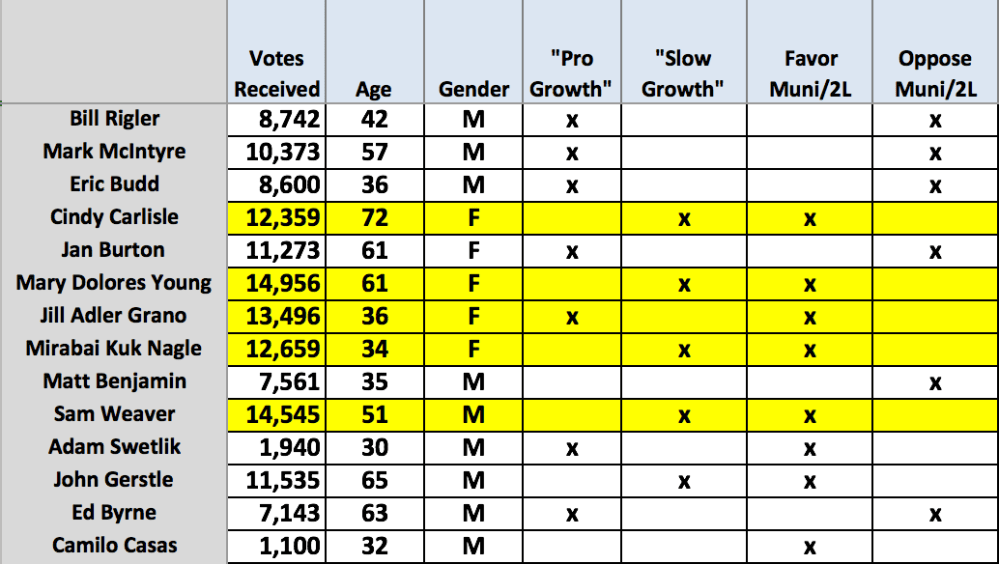
Basic information about the candidates, demographics, and positions. Winners highlighted. Note: I’ve made my best determination on “growth” positions to try to better guide the analysis. Individual candidates may have more nuanced positions than what I’m capturing here.

Screenshot 2017-12-18 21.27.00.png

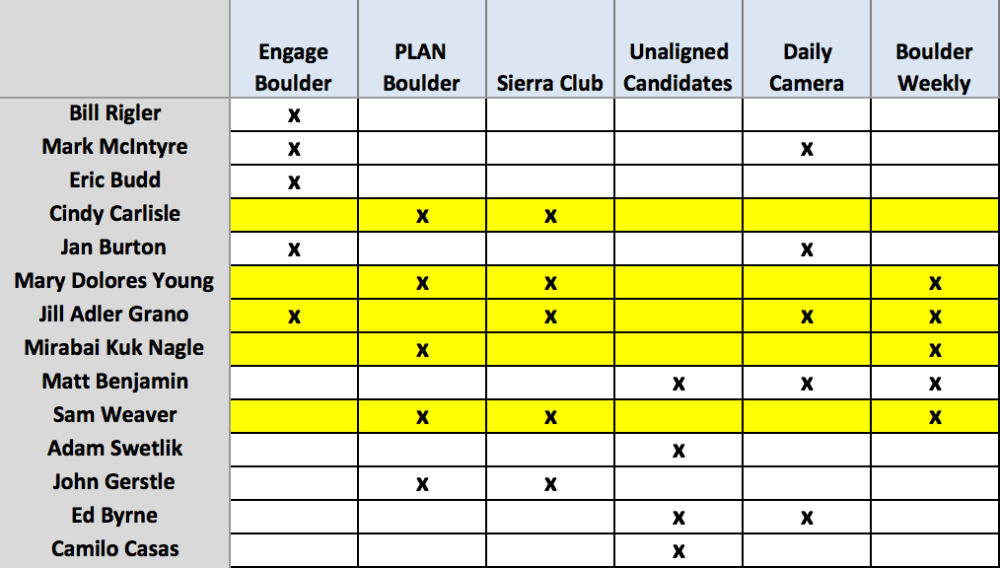
Various endorsements and groupings. Note: “Unaligned” candidates simply means candidates that were not endorsed by either Engage Boulder or PLAN Boulder.

Screenshot 2017-12-18 21.28.17.png

Turnout information – how many people voted in large demographic blocks?

    1. Total Ballots cast – 31,765 (43% turnout)
      • Ballots returned before election day – 18,109
      • Ballots returned on election day – 13,148
    2. Men / Women breakdown of voters – 48% vs 52%
    3. Votes cast for Men / Women
      • Votes for Men – 71,539 (52%), 7,949 on average
      • Votes for Women – 64,743 (48%), 12,949 on average
    4. Votes cast for various slates:
      • Engage Boulder endorsed candidates – 52,484 (10,497 on average)
      • PLAN-Boulder endorsed candidates – 66,054 (13,210 on average)
      • Independent candidates – 17,744 (4,436 on average)
    5. Votes cast candidates by support for energy utility:
      • Pro energy utility candidates – 82,590 (10,323 on average)
      • Against energy utility candidates – 53,692 (8,948 on average)

Candidate correlations – which candidates were most positively and negatively correlated with other candidates?

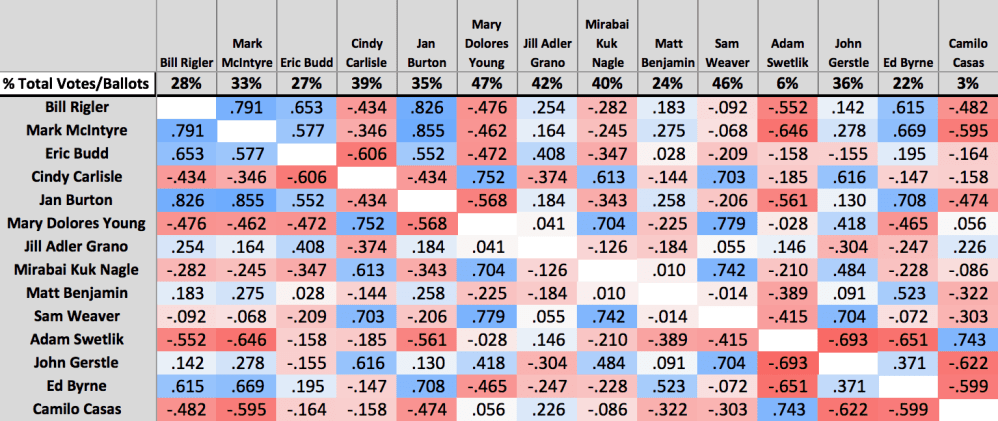
I’ll start by looking at which candidates were most positively or negatively correlated with other candidates. Each voter could vote for up to five candidates – voters on average used 4.3 of these 5 votes.

Screenshot 2017-12-14 12.28.15

    • Bill Rigler – Most positively correlated with Jan Burton (second-highest vote-getter on slate, incumbent, on the same Engage Boulder slate). Most negatively correlated with Adam Swetlik. Both are younger white men, although Bill’s votes general came from older, anti-muni voters which was largely the opposite of Adam’s base.
    • Mark McIntyre – Most positively correlated with Jan Burton, for similar reasons to Bill Rigler. Most negatively correlated with Adam Swetlik, probably also for similar reasons.
    • Eric Budd – Most strongly correlated with Bill Rigler (similar positions, demographics, on the same slate). Most negatively correlated with Cindy Carlisle (opposing positions, demographics, base of support)
    • Cindy Carlisle – Most positively correlated with Mary Young (top vote-getter on slate, similar positions and demographics). Most negatively correlated with Eric Budd.
    • Jan Burton – Most positively correlated with Mark McIntyre (similar positions, demographics, on the same slate, and third-highest vote-getter on slate). Most negatively with Mary Young (top vote-getter on opposing slate).
    • Jill Grano – Most positively correlated with Eric Budd (each supported each other). Most negatively correlated with Cindy Carlisle (may indicate vote swapping – same position on municipal energy, but otherwise very different candidates). Helpful to note that Jill had the least strong correlations of any candidate, likely because she was the most widely-endorsed and had a broad base of support.
    • Mirabai Nagle – Most positively correlated with Sam Weaver (same slate, positions). Most negatively strongly correlated with Eric Budd.
    • Matt Benjamin – Most positively correlated with Ed Byrne (both of whom were the two strongest independent candidates). Most negatively correlated with Adam Swetlik (positions, style of campaign, and of support much different)
    • Sam Weaver – Most positively correlated with Mary Young (other incumbent, both first elected in 2013, with same policy positions). Most negatively correlated with Adam Swetlik (interesting because they did some campaign events together, but generally had very different bases of support)
    • Adam Swetlik – Most positively correlated with Camilo Casas (another candidate in the race running a non-traditional campaign). Most negatively correlated with John Gerstle (who ran a traditional campaign, but largely got his votes from older voters while Adam got most of his votes from younger voters)
    • John Gerstle – Most positively correlated with Sam Weaver (second highest vote-getter on PLAN Boulder slate). Most negatively correlated with Adam Swetlik. John was positively correlated with the most number of other candidates (eight).
    • Ed Byrne – Most positively correlated with Jan Burton (positions, demographics, messaging). That likely means that Ed was not pulling many votes from Jan, but very likely pulled votes from others on the Engage Boulder slate. Most negatively correlated with Adam Swetlik (age of voter support being the largest factor).
    • Camilo Casas – Most positively correlated with Adam Swetlik (as younger, outsider candidates). Most negatively correlated with John Gerstle (older, establishment candidate).

Endorsing Groups – how closely did candidates correlate with other candidates in groups that endorsed?

I focus on five major groups—two slates of five candidates, the remaining four candidates, and the two newspaper endorsements.

Screenshot 2017-12-14 12.29.31

  • Engage Boulder

      • Most positively correlated – Bill Rigler
      • Most negatively correlated – Cindy Carlisle. Due to Cindy’s narrow loss in 2015 and serious threat in 2017, it’s likely that Engage Boulder found Cindy Carlisle to be the biggest threat and made significant efforts to try to prevent her from winning.
      • Special notes about Jill Grano and Ed Byrne – Jill had a broad base of support and different from the rest of the Engage Boulder slate because she supported the municipal energy utility, making her votes not as fully correlated with the group. Ed Byrne, while not on the slate, has networks and close ties with the endorsing groups of Engage Boulder, and led him to share votes with others on the slate.
  • PLAN Boulder

      • Most positively correlated – Sam Weaver
      • Most negatively correlated – Eric Budd (as someone who’s perhaps most well-known in political circles and has been routinely involved in issues on the opposite side of PLAN Boulder, this is not very surprising)
      • Notice how PLAN Boulder candidates are all highly correlated to the performance of their slate as a whole, such that no other candidate at all is positively correlated with votes of the PLAN Boulder slate as a whole.
  • Unaligned Candidates

      • Most positively correlated – Matt Benjamin (likely due to the benefit of both newspaper endorsements and edges out Ed Byrne here due to Ed’s ties with the Engage Boulder slate)
      • Most negatively correlated – Mary Young. (as the top vote-getter, Mary also had the strongest connections to the other PLAN Boulder candidates at the expense other relationships)
      • Note that both Adam Swetlik and Camilo Casas did not have a correlation to this group of independent candidates that they belonged.
  • The Daily Camera

      • Most positively correlated – Jan Burton. Endorsed in both 2015 and 2017, the Daily Camera also ran an editorial praising Burton two weeks prior to the endorsement editorial, giving Jan a boost.
      • Most negatively correlated – Adam Swetlik. Adam was not mentioned in the endorsements piece, and also had little presence in the newspaper generally.
      • Notes – Bill Rigler and Eric Budd both correlate higher than Matt Benjamin (who was endorsed), perhaps due to other newspaper aspects (positive mentions even though not receiving endorsement, advertising or letters to the editor)
  • The Boulder Weekly

      • Most positively correlated – Sam Weaver. Potentially due to very pro-muni stance of the paper.
      • Most negatively correlated – Adam Swetlik. Could reflect the demographics of the paper or lack of coverage.
      • Notes – While Matt Benjamin received the paper’s endorsement, it’s hard to see much benefit in the data presented. Since Matt opposed energy municipalization, while the paper was very much in favor, other non-endorsed candidates that favored municipalization like Cindy Carlisle and John Gerstle were more highly correlated.

How closely were groups correlated to each other?

Screenshot 2017-12-14 12.44.36

  • Engage Boulder and PLAN Boulder were not as negatively correlated as one might expect given the fact that these two groups were touted as the “slates” of the election, meaning there was plenty of crossover voting between the two slates.
  • PLAN Boulder and Sierra Club endorsed 4 of 5 of the same candidates and were highly correlated.
  • Ed Byrne and Matt Benjamin were highly correlated with Engage Boulder, meaning that one or both were often pulling votes from 1-2 candidates on the Engage Boulder slate.

Voter Age – how did each candidate’s votes correlate with voters of various age groups?

Voter age seemed to be a significant factor in which candidates voters cast votes for. Note that while younger voters made up 19% of ballots, they made a significantly fewer number of total votes (as each voter could cast up to five votes, but often younger voters cast fewer than five votes).

Screenshot 2017-12-17 23.11.55.png

    • Most positively correlated with older voters – Ed Byrne. Ed’s a long-time resident of Boulder and has an older network. He was also against energy utility municipalization which aligns with older voters.
    • Most negatively correlated with older voters – Adam Swetlik. As the youngest person running, Adam ran a campaign that seemed targeted to a younger demographic.
    • Age 18-32 – a large source of votes for Adam Swetlik and Camilo Casas, both younger candidates with non-traditional campaigns.
    • Age 33-65+ – Similar voting pattern overall. Some trend away from pro-muni and younger candidates with older voters.

Voting history and turnout likeliness – how did each candidates vote compared to the turnout history of voters and likeliness of turnout?

Voter behavior fell roughly into two groups based on voter history – those who did not vote in 2015, and those who were more consistent voters.

Screenshot 2017-12-14 12.47.24

  • Did not vote in 2015 – Adam Swetlik and Camilo Casas, two of the more outsider candidates, were very positively coordinated with this group. Ed Byrne and John Gerstle (who mainly saw their votes come from older voters) were the most negatively correlated.
  • Voted in 2015, 2013, and higher-turnout precincts – similar trends among all of these groups, and similar correlations to voters aged 50 and over.
  • % of Votes Cast – As each voter gets 5 votes, some voters will cast fewer votes, either for lack of knowledge of the candidates or for strategic voting purposes. Bill Rigler, Mark McIntyre, Sam Weaver, John Gerstle all had high correlations – likely due to slate effects (i.e. they received a lot of votes where voters voted for all 5 candidates of a slate). Ed Byrne also highly correlated, likely meaning that Ed was often a 5th vote correlated with the Engage Boulder slate, or otherwise. Older voters tended to use all five votes more often than younger voters on average.

Boulder’s Energy Utility – how did a candidate’s position on Boulder’s energy utility affect voter choices?

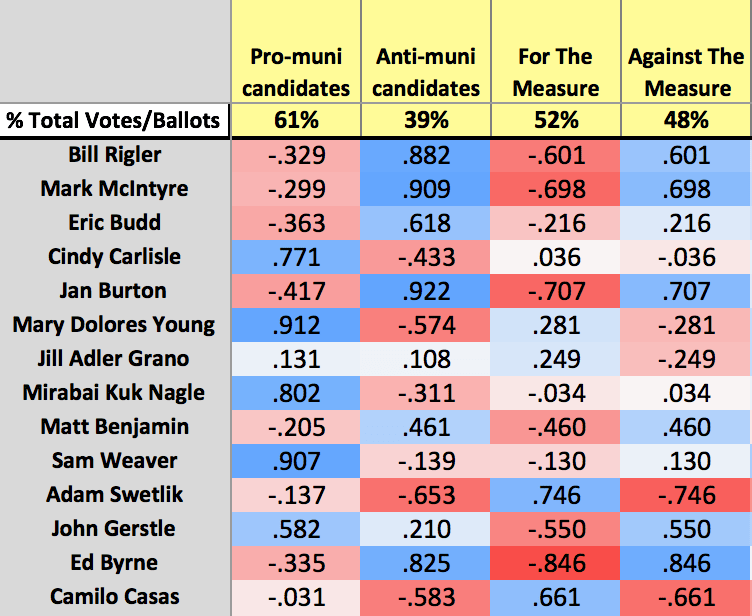
Ballot Measure 2L, the Utility Occupation Tax, was the most controversial and divisive issue facing voters in the 2017 election. Candidates’ position on the measure served as a proxy for their support for the Boulder’s municipal electric utility effort, or “muni” for short. Eight candidates supported the measure while six candidates opposed.

Two main parts of the analysis:

  1. How did a particular candidate or group correlate with other pro-muni or anti-muni candidates?
  2. How did a particular candidate or group correlate with votes for the measure or against the measure?

Interestingly, the data from these two questions was quite varied.

Screenshot 2017-12-17 23.18.43.png

  • Engage Boulder’s slate had one candidate for the muni effort and four candidates opposed. Their votes largely correlated in both candidates and issue voting.
  • PLAN Boulder’s slate had five candidates all in favor of the muni effort. However, their votes were slightly negatively correlated with votes against the measure. The most likely reason is that PLAN Boulder seemed to be trusted more on the issues of growth and development – voters mostly did not hold their pro-muni stance against them as they were empowered to vote against the muni ballot measure itself (which ultimately passed).

Screenshot 2017-12-17 23.15.00.png

  • Votes for pro-muni candidates were highly correlated with the PLAN-Boulder slate. Jill Grano, on the Engage Boulder slate, was positively correlated but quite distantly.
  • Votes for anti-muni candidates were very strongly split among seven candidates, leading to a stronger dilution of these votes.
  • Many of Sam Weaver’s supporters voted against the measure, even though he was in favor. Similarly for John Gerstle, who was correlated opposite how one would expect. His status as a well-known person who grew up in Boulder probably made the most difference with many older voters.

Screenshot 2017-12-17 23.32.42.png

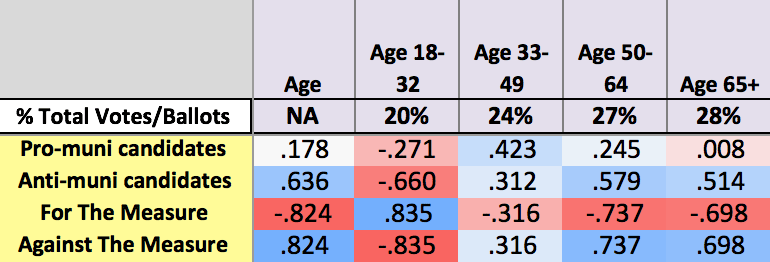
  • Voting among pro-muni candidates was slightly correlated with voter age, although voting for anti-muni candidates was highly correlated with voter age.
  • Voting for/against the measure was very highly correlated with age. Most likely reasons: the muni effort is ultimately about fighting climate change, which may raise costs and cause uncertainty, as well as require the city to take over the energy system—all reasons that older or more conservative voters often voted against the measure.

Screenshot 2017-12-17 23.33.37.png

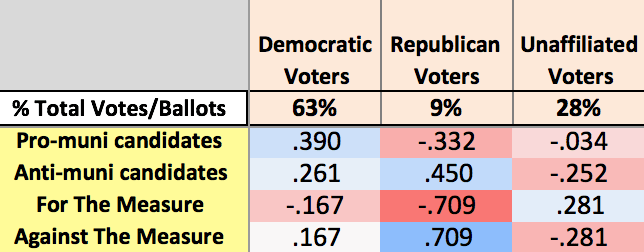
  • Democratic votes were reasonably likely to vote for pro-muni candidates even though they slightly were against the measure.
  • Republican voters both voted against the measure as well as tried to elect candidates who were not in favor of the measure.
  • Unaffiliated voters did not have a strong preference for candidates, but were more likely to support the measure (also aided by these voters trending younger)

Boulder’s Energy Utility – where did the votes come from in Boulder?

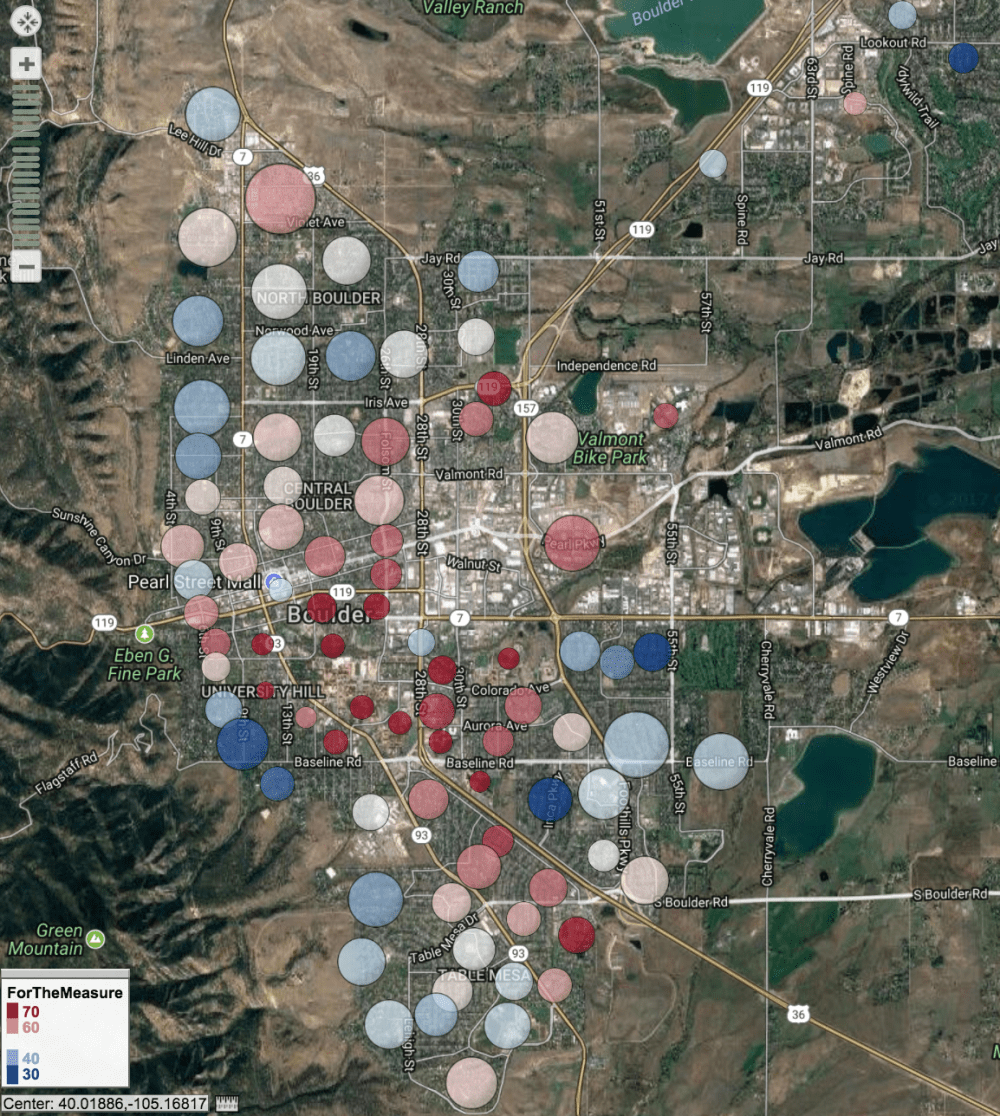
Click the image below for an interactive map that will show you how different parts of town voted on Ballot Measure 2L.

Screenshot 2017-12-18 15.02.00.png
Click for the interactive map!
  • Votes in favor of the electric utility largely came from precincts near the university with younger voters who vote at a much lower rate than the typical Boulder resident.
  • Votes against the electric utility were primarily located on the periphery of town, by older voters who often leaned Republican.

Party affiliation – how did a voter’s registration status compare with votes for each candidate?

Although Boulder City Council elections are non-partisan elections, Boulder has significant partisan effects in voting.

Screenshot 2017-12-14 12.56.12

Screenshot 2017-12-14 12.55.16

  • Democrats made up 63% of the voting base this year (even higher than their rate of registration), and were highly correlated with many of the more popular endorsing groups. The Sierra Club brand or slate of candidates performed particularly well with this group.
  • Republican voters were slightly correlated with Engage Boulder, which had four of six candidates against the municipal electric utility, however they were most correlated with Ed Byrne and Matt Benjamin. I think Ed and Matt benefitted from the anti-growth mentality that’s often found with Republicans and older voters, so they preferred these two candidates over the Engage Boulder slate.
  • Unaffiliated voters, largely younger, voted more highly for Adam Swetlik and Camilo Casas, who were two candidates running non-traditional campaigns.

Field plan correlation – how did voter contacts by various methods improve votes for Eric Budd (and various relations) through a strong field campaign?

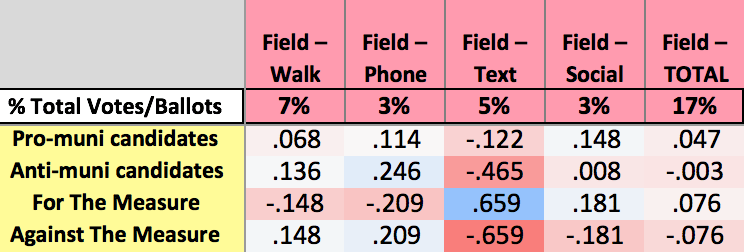
While I only have data for my own field plan, I can evaluate how effective the individual efforts were based on voter contacts in various precincts.

Screenshot 2017-12-14 12.59.04

  • Field – Walk: Our campaign knocked on about 1,500 doors during two months, and made a significant number of voter contacts. We can see a significant correlation with improved performance in those precincts.
  • Field – Phone: Our campaign made over 10,000 phone calls leading to about 600 voter contacts. We can see a significant impact from these efforts, although not as pronounced as the walk campaign.
  • Field – Text: Our campaign texted about 4,700 voters, of which about 1,600 voted. While we did worse with this population than you might expect, because our voters here trended younger and many younger voters voted for pro-muni candidates, we didn’t perform as well as desired with this group, even though it was significantly better than other anti-muni candidates on the slate.
  • Field – Social: This group focused on direct voter contacts on Twitter and had a significant affect, largely because this is a network of people I already knew. Jill Grano performed even better with this group, largely because we have similar age/networks, and she was a pro-muni candidate in a group of people that trended to be stronger in favor of muni.
  • Field – Total: Adding up all of these efforts, we can see a pronounced effect to increase my votes through a field team. The negative correlations in this column also show that my efforts likely won me votes over those particular candidates who may have occupied a similar demographic voting space.

Screenshot 2017-12-17 23.36.57.png

  • Because a decent number of voters also considered position on the energy utility as part of their vote, the correlation between this position and our field numbers is helpful to understand our relative success in difference areas.

PLAN Boulder performance compared to Engage Boulder – what was the affect of unaligned candidates?

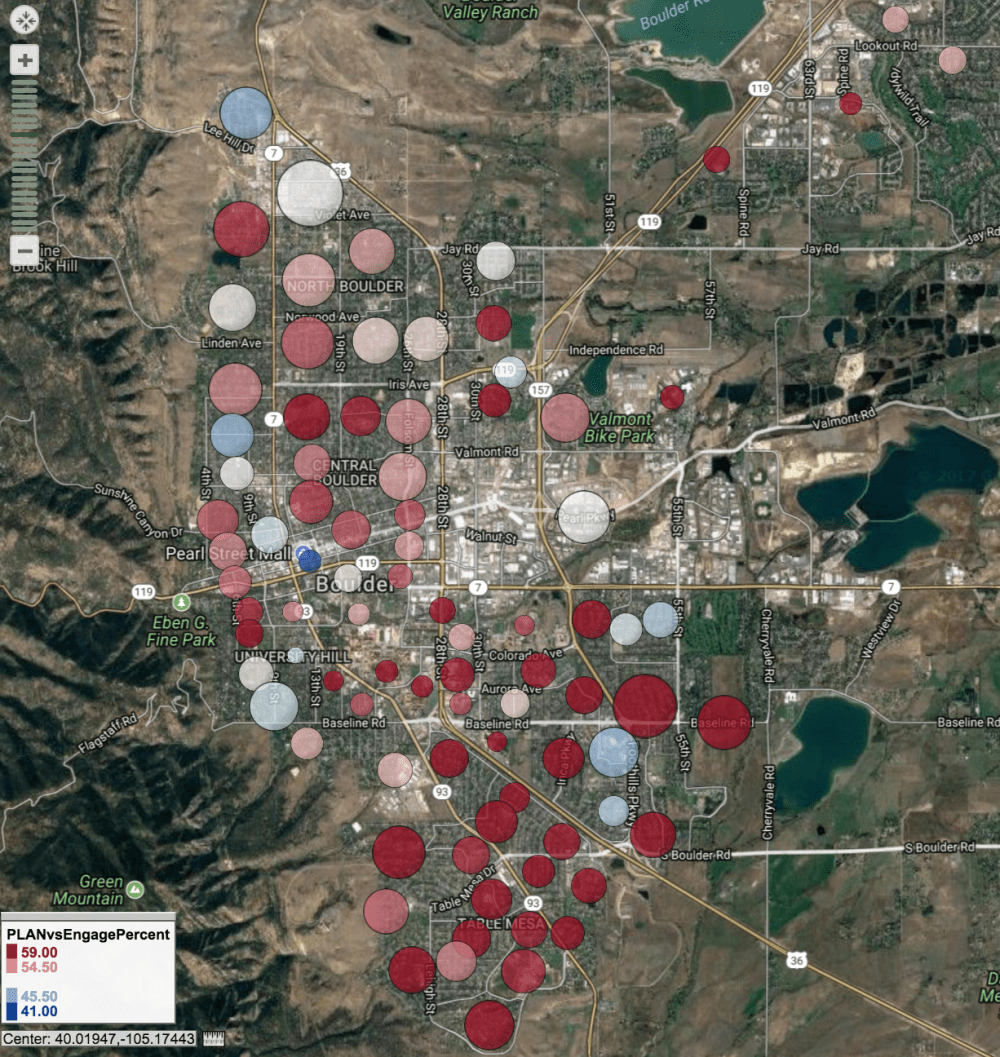
Click the image below for an interactive map that will show you how significantly PLAN Boulder won votes directly compared to Engage Boulder, as well as turnout and vote percentage totals for various precincts.

Screenshot 2017-12-18 15.06.55
Click for the interactive map!

Unaligned candidates received roughly 13.3% of the votes on average in precincts, ranging from a low of 8.9% to a high of 19.8%. While unaligned candidates were most likely correlated with Engage Boulder, they did not play a big factor in swinging the election for any particular slate or candidates.

How did controversial issues affect voting in nearby precincts? (Hogan-Pancost, CU South, Co-operative housing, Municipal Electric Utility, Twin Lakes)

The past twelve months have seen a number of highly controversial issues in Boulder. The map below shows precincts where PLAN Boulder won at least 60% of the vote compared to Engage Boulder. PLAN took advantage of voter concerns to win handily in these areas.

Boulder election map

  1. Hogan-Pancost —  Concerns about the development of this difficult property won about 1,000 votes for PLAN Boulder candidates. “Boulder residents object to Hogan-Pancost plans at Planning Board meeting” (Daily Camera)
  2. CU South — Boulder City Council moved on this issue to try to address immediate flooding danger in Southeast Boulder. However, neighbors have concerns about traffic and future development from an agreement with CU Boulder. Boulder City Council approves new land-use designation for CU South (Daily Camera)
  3. Co-operative housing — While the addition of a cooperative housing ordinance does not explicitly affect Martin Acres, residents there have been concerned that the neighborhood’s affordable nature would bring more housing cooperatives to that part of town. At long last, Boulder approves new co-op housing ordinance (Daily Camera).Potential Boulder co-op’s size concerns Martin Acres neighbors (Daily Camera)
  4. Twin Lakes — Residents opposed a change in land use to build affordable housing, an issue that required approval from both the city and county. Twin Lakes Action Group spin-off Greater Gunbarrel to raise money for Boulder candidates (Daily Camera)
  5. Municipal Electric Utility — Again, while not a location-specific issue, younger voters in these precincts near CU voted both in favor of the electric utility as well as in favor of majority PLAN Boulder candidates. Student vote may have rescued Boulder municipalization — New Era Colorado registered 2,075 people in promoting ballot issue 2L (Daily Camera)

Why I will run for Boulder City Council

I’d love your help and input through this journey. Send me a note, tell me how you’d like to help, or feel free to set up a meeting if you’d like to get together. Thank you!

I’ve been involved for several years as an advocate for equity in housing and transportation challenges in Boulder, have served on a city board, and want to get involved further.

I’ve written about why and how these goals are important to me:

I’ve been proud to work with several groups and boards on these issues the past few years:

Who I am and what distinguishes me as a candidate for city council:

I have lived in Boulder less than 10 years

I’ve lived in Boulder long enough to become part of the culture and people, but still have an outside perspective. I’m part of the next generation of people coming to Boulder, bringing new energy to serve the community and carry our values forward

I am an economist by education

I live and breathe economics because I want to understand people through understanding markets, constraints, and relative-choice decisions. Being data-driven helps take the emotional component out and not be driven by fear or anger. I respond with dispassionate evaluation, and then a passionate response supported by data.

I am part of the younger generation (35) and don’t yet have a family

Many in my generation have not started a family, or greatly delayed one—particularly in Boulder with high housing prices and few options to stay for the long-term. I plan to stay in Boulder and make the city work as many in my peer group are making hard choices to live in other communities to purchase a home or start a family.

I live in multi-family housing and don’t own a car

Like many in Boulder, I value experiences over possessions and material things, which is especially true of the younger generation. I value having a smaller footprint, living in a strong community, and sharing. Many in Boulder make sacrifices in order to live here. Giving up items like a larger place to live or the convenience of a car is both necessary for me to live in Boulder and also a choice to be efficient, low-cost, healthy, and find creative solutions to marry my values with how I live.

I am open, transparent, and work to help educate and bring people in.

Although I’m not unique in these attributes, I’ve spent much of my time and effort to help inform people who aren’t in the standard circles and bringing them into the conversation. I’m always looking for new and creative ways to meet and connect with more people in the community, getting involved in new groups and putting myself out there, listening. I’m always seeking out people who are creative, value education, progressive, engage ideas and conversation, curious, adventurous, courageous, driving toward evolution, progress, equality, community, inclusiveness, and creative solutions.

You can connect with me on Twitter at @ericmbudd.

Boulder’s Struggle to Meet Its Ideals

This piece first ran in The Denver Post.

Boulder, Colorado prides itself on progressive values, striving to lead in sustainability and limiting climate change. But as city leaders grapple with unaffordable housing and pressures from growth, attempts to find balance in a changing character cause Boulder to fall short of its ideals on many fronts.

In housing specifically, the city council speaks for their desire to create “15-minute neighborhoods” where residents can walk and bike to services, to improve bus and bike infrastructure, and build housing for the “missing middle” as a greater number of middle-income families can no longer to afford to live in Boulder. But an example of one recently proposed housing development accomplishing many of those goals was unanimously rejected by Boulder’s Planning Board.

The housing development “Iris and B” would have provided 50 middle-income housing units on the city’s most active transit corridor. The project would have fulfilled many of the stated goals: providing a neighborhood coffeeshop or restaurant, a diverse mix of housing targeted at 80 to 120% of the median area income, connecting to a bike route and having a six minute bus ride downtown. The units would have ranged from small efficiency-style up through three-bedroom condominiums for families, using smaller footprint designs that reduce the amount of heating, cooling, and water use per person.

The planning board ruled an increased zoning for the development would be “too dense” for the neighborhood, even though Broadway is a four-lane arterial with frequent bus service. Concerns about worsening traffic from this relatively modest development drew criticism, even though a majority of traffic on the corridor in peak hours results from commuters outside of the city limits, part of Boulder’s 65,000 regional daily in-commuters. Rather than supporting a project which meets its long-term goals of reducing vehicle miles traveled and providing more affordable housing options, Boulder’s planning board instead supported a development pattern which worsens the city’s long-term difficulties.

Another example is Boulder’s effort to pass a workable cooperative housing ordinance. A housing cooperative is a group of individuals who share meals and housekeeping tasks to improve affordability, reduce energy use, emissions and food waste per person. Boulder, like many cities, has laws limiting occupancy of unrelated people living in a house, setting a limit of three people per house in low-density zoning areas. Reducing the number of people living in a house, particularly when new homes continue to increase in size, greatly limits affordable housing options for people outside of a traditional family or without a high income. Passing an ordinance to enable housing cooperatives would gain community benefits while limiting impacts on existing neighborhoods relating to the potential for additional noise, trash, or car parking needs.

On Tuesday December 6th, the Boulder City Council met to update the proposed draft ordinance which would permit groups to create up to fourteen co-ops per year, allowing up to twelve people, and requiring separation between housing cooperatives to limit any impacts on neighborhoods. Yet by the end of the evening, some council members, responding to concerns of neighbors, insisted that occupancy be more heavily restricted by square footage per person, house size, and lot size, such that most of the currently legal or potentially legal co-ops in Boulder could not exist under the new law. Now several co-ops risk eviction with the proposed law as written. On the same night, Boulder City Council unanimously supported a climate goal of an 80% emissions reduction by 2050, showing a significant disconnect between policy ideals and laws that directly accomplish those ideals.

Boulder is a community that has both the wealth and resources to carry out its ambitious plans. Now Boulder needs to take the real steps required to make a lasting impact on sustainable climate in ways that promote a diverse and inclusive community.

Eric Budd is a resident of Boulder working on equitable housing and transportation policy. You can tweet him at @ericmbudd.

Key items to making a workable cooperative housing ordinance in Boulder

My email to Boulder’s City Council on Sunday, December 4th. Please considering writing the city council at council@bouldercolorado.gov and BCC’ing legalizecoops@gmail.com with support for a cooperative housing ordinance.

I support the proposed cooperative housing ordinance — as you’re reading lots of email on co-ops, I’ll keep this to what I see as the few most important items for council discussion on Tuesday 12/6.

1. Occupancy – The two main adjustments council could make to occupancy are in the range of total co-op size and square feet per person. In low-density zones, it’s critical that council enable co-ops of at least 12 people and/or 200 square feet per person. The main reason for this: existing legal and sub-legal communities have formed in the range of these numbers to get a workable scale and affordability.

An existing co-op of 14 people at 200 square feet per person, if moving to either 10 people or 250 square foot per person, would lose several members of their house and show an increase of rent by 40% in the former case and 25% in the latter case, seriously putting the economics of entire houses at risk—not only for rent, but for food, water, and energy purposes, which all decrease per capita in larger homes.

2. Minimum house size and concentration – Both of these adjustments have significant effects on the supply of available houses to create co-ops, so I would like to see great care in moving these numbers from the current proposed ordinance as written. In low-density zones, the current minimum house size at 2,000 square feet has uneven effects of limiting the supply of available houses across the city, which may be a desired outcome to limit co-ops in neighborhoods like Martin Acres, but combined with the current 500 foot separation, even more greatly restricts the number of available houses in parts of town with larger homes.

BoCHA’s analysis of the city housing data shows that only 28.4% of rental houses in the city are greater than 2,000 square feet, and only 53.6% of non-rental houses. I ask that council really dig into the relationship between these two pieces of data to ensure co-ops can actually be created with the proposed restrictions.
On a personal note, I think council has gone above and beyond in engaging with the community and housing advocates. Thank you for your hard work and effort to understand the important details required to get to a workable cooperative housing ordinance.
Eric Budd
3025 Broadway St. #38
Boulder, CO 80304
@ericmbudd

Boulder’s 2016 Ballot: How I’m voting on national, state, and local issues

I am a registered Democrat and generally vote for Democrats unless having a strong reason to vote for another candidate. I’m mainly interested to give my positions on state and local ballot measures, which people have a variety of viewpoints regardless of party.

A note about the presidential race specifically: I am voting for Hillary Clinton. I am not simply voting against Donald Trump, nor voting for Jill Stein or Gary Johnson. While I supported Bernie Sanders in the primary and some of Hillary’s past decisions have bothered me, I believe that the Democrats are the progressive party in this country and we need to continue to work at every level of government to keep driving positive change in the party. Hillary is uniquely qualified to lead the country.

I am happy to cast my vote for the United States’ first woman president, Hillary Clinton.

Presidential Electors Hillary Clinton / Tim Kaine
Democratic
United States Senator Michael Bennet
Democratic
Representative to the 115th United States Congress –
District 2
Jared Polis
Democratic
Regent of the University of Colorado – At Large Alice Madden
Democratic
State Senator – District 18 Stephen Fenberg
Democratic
State Representative – District 13 KC Becker
Democratic
District Attorney – 20th Judicial District Stan Garnett
Democratic
County Commissioner – District 1 Elise Jones
Democratic
County Commissioner – District 2 Deb Gardner
Democratic


Colorado State Ballot Measures

Amendment T
YES/FOR
Shall there be an amendment to the Colorado
constitution concerning the removal of the exception to the
prohibition of slavery and involuntary servitude when used as
punishment for persons duly convicted of a crime?

I am voting YES on the measure. Colorado needs to go even further to eliminate prison labor entirely.

Amendment U
YES/FOR
Shall there be an amendment to the Colorado constitution
concerning an exemption from property taxation for a
possessory interest in real property if the actual value of the
interest is less than or equal to six thousand dollars or such
amount adjusted for inflation?

I am voting YES on the measure. The measure would reduce costs for local governments as the cost of collecting these taxes outweighs the average tax assessment ($24 per affected person).

Amendment 69
YES/FOR
SHALL STATE TAXES BE INCREASED $25 BILLION
ANNUALLY IN THE FIRST FULL FISCAL YEAR, AND BY
SUCH AMOUNTS THAT ARE RAISED THEREAFTER, BY AN
AMENDMENT TO THE COLORADO CONSTITUTION
ESTABLISHING A HEALTH CARE PAYMENT SYSTEM TO
FUND HEALTH CARE FOR ALL INDIVIDUALS WHOSE
PRIMARY RESIDENCE IS IN COLORADO, AND, IN
CONNECTION THEREWITH, CREATING A GOVERNMENTAL
ENTITY CALLED COLORADOCARE? (Truncated…)

Perhaps the most difficult item on the ballot this year. I am voting YES on the measure. A number of notable politicians in Colorado have come out against ColoradoCare. Although some details of the proposed law may need to be improved, the net benefits in covering an entire population and reducing overhead from insurance companies could outweigh the costs.

Here’s an op-ed in favor of the measure by Colorado State Senator Irene Aguilar: Yes on Amendment 69: Coloradans should take back their health care

Amendment 70
YES/FOR
Shall there be an amendment to the Colorado constitution
increasing the minimum wage to $9.30 per hour with annual
increases of $0.90 each January 1 until it reaches $12 per hour
effective January 2020, and annually adjusting it thereafter for
cost-of-living increases?

I am voting YES on the measure. The phased-in approach and cost-of-living adjustments are smart policy. Although some groups are pushing for a higher minimum wage, giving the geographical disparities in Colorado, a higher minimum may have huge impacts on rural parts of Colorado while still not being sufficient for some of its cities. I think this measure finds an appropriate balance without having a more localized policy.

Amendment 71
NO/AGAINST
Shall there be an amendment to the Colorado constitution
making it more difficult to amend the Colorado constitution by
requiring that any petition for a citizen-initiated constitutional
amendment be signed by at least two percent of the registered
electors who reside in each state senate district for the
amendment to be placed on the ballot and increasing the
percentage of votes needed to pass any proposed constitutional
amendment from a majority to at least fifty-five percent of the
votes cast, unless the proposed constitutional amendment only
repeals, in whole or in part, any provision of the constitution?

I am voting NO on the measure. While raising the amending the constitution for measures like marijuana or personhood may seem inappropriate, voters do have the ability to weigh-in on important issues. Colorado doesn’t currently have the problem of dozens of measures each election cycle like California does, and notable measures (like those against oil and gas) in fact failed to get on the ballot this year. The proposed changes would make it certain that only well-funded and organized efforts could have any possibility to get on the ballot in the future, and it would be very difficult to fix problematic items currently in the constitution (like TABOR).

Amendment 72
YES/FOR
SHALL STATE TAXES BE INCREASED $315.7 MILLION
ANNUALLY BY AN AMENDMENT TO THE COLORADO
CONSTITUTION INCREASING TOBACCO TAXES, AND, IN
CONNECTION THEREWITH, BEGINNING JANUARY 1, 2017,
INCREASING TAXES ON CIGARETTES BY 8.75 CENTS PER
CIGARETTE ($1.75 PER PACK OF 20 CIGARETTES) AND ON
OTHER TOBACCO PRODUCTS BY 22 PERCENT OF THE
MANUFACTURER’S LIST PRICE; AND ALLOCATING
SPECIFIED PERCENTAGES OF THE NEW TOBACCO TAX
REVENUE TO HEALTH-RELATED PROGRAMS AND
TOBACCO EDUCATION, PREVENTION, AND CESSATION
PROGRAMS CURRENTLY FUNDED BY EXISTING
CONSTITUTIONAL TOBACCO TAXES; AND ALSO
ALLOCATING NEW REVENUE FOR TOBACCO-RELATED
HEALTH RESEARCH, VETERANS’ PROGRAMS, CHILD AND
ADOLESCENT BEHAVIORAL HEALTH, CONSTRUCTION
AND TECHNOLOGY IMPROVEMENTS FOR QUALIFIED
HEALTH PROVIDERS, EDUCATIONAL LOAN REPAYMENT
FOR HEALTH PROFESSIONALS IN RURAL AND
UNDERSERVED AREAS, AND HEALTH PROFESSIONAL
TRAINING TRACKS?

I am voting YES on the measure. While the major concern is that cigarette taxes fall onto lesser educated, poorer populations—so do the negative health effects. The law’s funding would mostly target those who are most affected. Colorado currently ranks 43rd highest on cigarette taxes out of 56 states and territories, and the proposed law would move the state to 12th on that list.

Proposition 106
YES/FOR
Shall there be a change to the Colorado revised statutes to
permit any mentally capable adult Colorado resident who has a
medical prognosis of death by terminal illness within six months
to receive a prescription from a willing licensed physician for
medication that can be self-administered to bring about death;
and in connection therewith, requiring two licensed physicians to
confirm the medical prognosis, that the terminally-ill patient has
received information about other care and treatment options,
and that the patient is making a voluntary and informed decision
in requesting the medication; requiring evaluation by a licensed
mental health professional if either physician believes the patient
may not be mentally capable; granting immunity from civil and
criminal liability and professional discipline to any person who in
good faith assists in providing access to or is present when a
patient self-administers the medication; and establishing
criminal penalties for persons who knowingly violate statutes
relating to the request for the medication?

I am voting YES on the measure. The need for right-to-die legislation affects a small amount of the population, but in cases of significant debilitating diseases can make a large impact on the individuals themselves and their families. According to the Oregon law, “1,545 people have received end-of-life drug prescriptions, and 991 used the medication between 1999 and the end of 2015, according to the Oregon Public Health Division,” showing that this option is used very rarely. Requiring two doctors and a mental health professional to sign off on the measure should be an appropriate safeguard against misuse or abuse.

Proposition 107
YES/FOR
Shall there be a change to the Colorado Revised Statutes
recreating a presidential primary election to be held before the
end of March in each presidential election year in which
unaffiliated electors may vote without declaring an affiliation with
a political party?
Proposition 108
YES/FOR
Shall there be a change to the Colorado Revised Statutes
concerning the process of selecting candidates representing
political parties on a general election ballot, and, in connection
therewith, allowing an unaffiliated elector to vote in the primary
election of a political party without declaring an affiliation with
that party and permitting a political party in specific
circumstances to select all of its candidates by assembly or
convention instead of by primary election?

I am voting YES on the measures. The caucus system used currently disenfranchises many people who are unable to spend several hours on a certain weeknight in order to participate in the political process, including people doing shift work or needing childcare. The caucus system also failed both Democrats and Republicans this year by having inadequate capacity to serve the public in the former, and bypassing the system entirely in the latter. A state-run system would be less likely to face either problem.

Allowing independents to vote may have the effect of reducing partisan affiliation, which is why the state chairs of both the Democratic and Republican parties oppose the measure.

Another marked change from the current systems is to assign a winner of the primary the entire set of delegates instead of a proportional division. That could have some variable effects depending on how competitive Colorado or other states are in a national election, making the state potentially more or less desirable to spend resources in a given year. I’m neutral on that aspect of the measure.

Here’s a good debate on both sides of these measures: Point/counterpoint: Should voters approve Propositions 107 and 108?

Boulder County Ballot Measures

COUNTY ISSUE 1A

(Road and Bridge Mill Levy Increase):
NO/AGAINST

SHALL BOULDER COUNTY TAXES BE INCREASED $5.5
MILLION ANNUALLY (FIRST FULL FISCAL YEAR DOLLAR
INCREASE IN 2017) THROUGH AN INCREASE IN BOULDER
COUNTY’S AD VALOREM PROPERTY TAX MILL LEVY OF
0.785 MILLS, FOR FIFTEEN YEARS TO AND INCLUDING
DECEMBER 31, 2031, FOR THE PURPOSE OF FUNDING
ROAD AND BRIDGE PROJECTS WITHIN THE
MUNICIPALITIES IN BOULDER COUNTY AND
REHABILITATION OF PAVED PUBLIC LOCAL ACCESS
SUBDIVISION ROADS IN UNINCORPORATED BOULDER
COUNTY, SUCH INCREASE IN PROPERTY TAX REVENUES
TO BE IN EXCESS OF THAT WHICH WOULD OTHERWISE
BE PERMITTED UNDER SECTION 29-1-301, C.R.S., EACH
YEAR WITHOUT SUCH INCREASE; AND SHALL THE
REVENUES AND EARNINGS ON THE INVESTMENT OF THE
PROCEEDS OF SUCH TAX, REGARDLESS OF AMOUNT,
CONSTITUTE A VOTER-APPROVED REVENUE CHANGE
AND A PROPERTY TAX REVENUE CHANGE; ALL AS MORE
PARTICULARLY SET FORTH IN BOARD OF COUNTY
COMMISSIONERS’ RESOLUTION NO. 2016-89?

I am voting NO on the measure. Boulder County has sufficient funds for common road and bridge projects within the county, and also sufficient funds to repair subdivision roads (albeit at a slower pace than these homeowners desire). Advocates for additional subdivision road spending in the county have repeatedly rejected funding local improvement districts or converting these roads to lower-cost roads. The measure would cause a disproportionate funding for subdivision roads to be paid for by residents of cities (Boulder, Longmont, Louisville) rather than residents of these subdivisions.

COUNTY ISSUE 1B

(Countywide Open Space Sales and Use Tax Bond

Authorization and Tax Extension):
YES/FOR

SHALL BOULDER COUNTY DEBT BE INCREASED BY UP TO
$30 MILLION, WITH A MAXIMUM REPAYMENT COST OF UP
TO $54 MILLION, WITH NO INCREASE IN ANY COUNTY TAX
OR TAX RATE, BY THE ISSUANCE OF REVENUE BONDS
FOR THE PURPOSE OF OPEN SPACE LAND ACQUISITION,
WHICH BONDS SHALL BEAR INTEREST, MATURE, BE
SUBJECT TO REDEMPTION, WITH OR WITHOUT PREMIUM,
AND BE ISSUED, DATED AND SOLD AT SUCH TIME OR
TIMES, AT SUCH PRICES (AT, ABOVE OR BELOW PAR) AND
IN SUCH MANNER AND CONTAINING SUCH OTHER
TERMS, NOT INCONSISTENT HEREWITH, INCLUDING
PROVISIONS FOR FUNDING ANY CAPITALIZED INTEREST
AND REQUIRED RESERVES, AS THE BOARD OF COUNTY
COMMISSIONERS MAY DETERMINE;
AND SHALL ONE-HALF (0.125%) OF THE COUNTY’S
EXISTING 0.25% SALES AND USE TAX FOR OPEN SPACE,
CURRENTLY SET TO EXPIRE DECEMBER 31, 2019, BE
EXTENDED FOR AN ADDITIONAL PERIOD OF FIFTEEN
YEARS TO AND INCLUDING DECEMBER 31, 2034 FOR THE
PURPOSE OF FUNDING THE OPEN SPACE PROGRAM [Truncated]
COUNTY ISSUE 1C

(Countywide Sustainability Sales and Use Tax

Extension):
YES/FOR

WITH NO INCREASE IN ANY COUNTY TAX OR TAX RATE,
SHALL ONE-HALF (0.125%) OF THE COUNTY’S EXISTING
0.25% SALES AND USE TAX FOR OPEN SPACE,
CURRENTLY SET TO EXPIRE DECEMBER 31, 2019, BE
EXTENDED FOR AN ADDITIONAL PERIOD OF FIFTEEN
YEARS TO AND INCLUDING DECEMBER 31, 2034 FOR THE
PURPOSE OF FUNDING SUSTAINABILITY
INFRASTRUCTURE AND PROGRAMS [Truncated]

I am voting YES on the measures. Both support preserving existing taxes that enable open-space in the county, while diverting a portion of the existing tax (which is not needed for the current open-space plan) to provide sustainable transportation options in the county.

County Question 1D

(District Attorney Term Limit Extension to Four

Terms):
NO/AGAINST

Shall the term limits imposed by state law and in Article XVIII,
Section 11, of the Colorado Constitution on the office of District
Attorney of Boulder County, Twentieth Judicial District, be
modified so as to permit an elected officeholder in that office to
seek and, if the voters of Boulder County choose to re-elect that
person to a fourth term in office, to serve a fourth consecutive
term?

I am voting NO on the measure. Each term is four years and the extension would allow a district attorney to serve 16 years instead of 12 years, which is a long time for one person to hold the office.

Boulder City Ballot Measures

CITY OF BOULDER BALLOT ISSUE 2H

SUGAR SWEETENED BEVERAGE PRODUCT

DISTRIBUTION TAX
YES/FOR

SHALL CITY OF BOULDER TAXES BE INCREASED $3.8
MILLION (FIRST FULL FISCAL YEAR INCREASE) ANNUALLY
BY IMPOSING AN EXCISE TAX OF 2 CENTS PER OUNCE ON
THE FIRST DISTRIBUTOR IN ANY CHAIN OF DISTRIBUTION
OF DRINKS WITH ADDED SUGAR, AND SWEETENERS
USED TO PRODUCE SUCH DRINKS, EXEMPTING: (1)
SWEETENERS SOLD SEPARATELY TO THE CONSUMER AT
A GROCERY STORE; (2) MILK PRODUCTS; (3) BABY
FORMULA; (4) ALCOHOL; AND (5) DRINKS TAKEN FOR
MEDICAL REASONS;
AND IN CONNECTION THEREWITH, SHALL ALL OF THE
REVENUES COLLECTED BE USED TO FUND: THE
ADMINISTRATIVE COST OF THE TAX, AND THEREAFTER
FOR HEALTH PROMOTION, GENERAL WELLNESS
PROGRAMS AND CHRONIC DISEASE PREVENTION IN THE
CITY OF BOULDER THAT IMPROVE HEALTH EQUITY,
SUCH AS ACCESS TO SAFE AND CLEAN DRINKING
WATER, HEALTHY FOODS, NUTRITION AND FOOD
EDUCATION, PHYSICAL ACTIVITY, OTHER HEALTH
PROGRAMS ESPECIALLY FOR RESIDENTS WITH LOW
INCOME AND THOSE MOST AFFECTED BY CHRONIC
DISEASE LINKED TO SUGARY DRINK CONSUMPTION [Truncated]

According to my Twitter feed, the sugary drink tax is the most controversial issue on the local ballot. I am voting YES on the measure.

My support bases on several key pieces of evidence:

  1. The Berkeley sugary drink tax has reduced sugary drink consumption and increased water consumption compared to neighboring cities. Boulder’s tax is modeled after this tax. Berkeley sees a big drop in soda consumption after penny-per-ounce ‘soda tax’
  2. The tax is not a grocery tax, nor does it directly affect prices at grocery stores. The tax is levied on distributors and not individual businesses. An economic analysis of the tax in Berkeley showed that “47% of the penny-per-ounce tax had been passed along to consumers in the form of higher prices for sugar-sweetened beverages, according to a previous study by some of the same researchers. For sodas in particular, 69% of the tax was incorporated into the price.” This means that the distributor or producer absorbed 31% of the price, reducing their profits. Boulder’s tax is higher, putting more pressure on distributors to absorb more of the price increase while also ensuring that the tax raises the price for consumers (which is required to change behavior).
  3. The taxes collected will benefit poorer populations and minorities. As the ballot language states, the revenue collected will go to “improve health equity, such as access to safe and clean drinking water, healthy foods, nutrition and food education, physical activity, other health programs especially designed for residents with low income and those most affected by chronic disease linked to sugary drink consumption.” In my opinion this counteracts any problems with a regressive nature of the tax. It’s also important to understand that the sugar industry targets low-income and minority populations specifically: Washington Post: “When soda companies target minorities, is it exploitation?”
  4. Sugary drinks directly relate to cardiovascular disease, diabetes, and premature death. “Sugary Drinks Take a Deadly Toll
  5. The sugar industry has systematically tried to influence public policy to protect sugar. “An article in JAMA Internal Medicine reported that in the 1960s, the sugar industry paid Harvard scientists to publish a study blaming fat and cholesterol for coronary heart disease while largely exculpating sugar.” NYTimes – How the Sugar Industry Shifted Blame to Fat, The Shady History of Big Sugar
  6. The World Health Organization directly supports a sugary drink tax, as does the American Heart Association. W.H.O. Urges Tax on Sugary Drinks to Fight Obesity

Here’s why I think arguments in opposition are not very compelling:

  1. “Boulder is mostly white and has a 12% obesity rate”

Boulder may seem an unnecessary place for such a tax, but here’s why I think it’s still worthy to support. Boulder does have minority and poorer populations, even if they are a smaller portion of the city than most consider. These populations are important to protect for many reasons, particularly because they’re vulnerable and give Boulder much of its racial and ethnic diversity. Revenues raised would benefit them most.

  1. “Other items with sugar [i.e. yogurt, frappuccino] aren’t being targeted like sugary drinks”

While added sugar in any form can contribute to negative health outcomes, sugary drinks are very easily and quickly consumable and habit-forming. Added sugar in grocery foods is a problem not covered in this tax, but I do not believe that is a reason not to support the tax. Items like frappuccino made in a coffeeshop or restaurant are not covered due to their inherently high cost as a full-service item. However, a frappuccino sold in a store would be required to pay the tax.

  1. “The tax is regressive and disproportionately targets poorer populations and makes food scarcity worse”

As I made clear above, the sugar industry already targets poorer populations with marketing. The sugary drink tax does not contribute to food scarcity because sugary drinks should not be considered food, and healthier alternatives will be more attractive given the additional tax on sugary drinks.

City of Boulder Ballot Question 2I

Clarify and Amend Blue Line, Water Not Supplied

West of Line
YES/FOR

Shall the boundary described in Boulder Home Rule Charter
section 128A and approved by the voters in 1959 that provides
that the City of Boulder shall not supply water for domestic,
commercial, or industrial uses to land lying on the westward side
of the line be amended to clarify the location of the boundary
and to allow the provision of water service to existing developed
properties as described in Ordinance No. 8133, and further shall
the standards in Charter section 128A be amended to clarify the
conditions and eligibility for water service as described in
Ordinance No. 8133?

I am voting YES on the measure. The measure works to clarify an existing section of the charter without significant change to the existing line. Image below in this Daily Camera piece: Boulder’s murky Blue Line could get clarity from voters in November

NewBlueLine

City of Boulder Ballot Question 2J

Provide Insurance Benefits for Council Members

YES/FOR

Shall section 7, “Compensation,” of the Boulder Home Rule
Charter be amended pursuant to Ordinance No. 8132 to allow
council members serving on January 1, 2020 and after to be
eligible to receive benefits under the same terms and conditions
that are available to full-time city employees including without
limitation participation in city health, vision, dental and life
insurance plans?

I am voting YES on the measure. The measure provides a significant and needed benefit to members of the city council, whom make approximately $12,000 per year for a job that typically consumes 25 or greater hours per week. Given that previous pay increases have been rejected, this is a measure that would help increase the supply of people who might consider serving on the city council.

City of Boulder Ballot Question 302

Qualifications of Council Members
YES/FOR

Shall section 4 of the Boulder Home Rule Charter be amended
by adding a new paragraph to restrict council members to three
terms in the person’s lifetime, which requirement shall apply to
any candidate for council after November 8, 2016?

I am voting YES on the measure. I will review a number of arguments against the measure:

“Term limits are not needed based on historical precedent and have the appearance of targeting current council members”

While Richard Valenty makes a compelling case against term limits using historical data, the strength of incumbency and bias toward older and retired members of the community are powerful counter-arguments.

“The measure only reduces the supply of people who can run for city council, and does not increase it”

I agree that the measure would reduce the supply of people available to run for council, and does not address other reasons that other demographics do not run (very little pay and benefits). I support both increasing city council pay and increasing benefits (City of Boulder Ballot Question 2J)

“Other policy to increase equity in who can run for city council is more important”

I agree. Yet the policy on term limits is reasonable policy looking forward as the city grows, while recognizing the need that Boulder has more work ahead to give broader representation of various people who may run for city council.

BOULDER VALLEY SCHOOL DISTRICT BALLOT

ISSUE 3A:

YES/FOR

SHALL BOULDER VALLEY SCHOOL DISTRICT RE-2 TAXES
BE INCREASED BY $10,000,000 IN 2016 FOR COLLECTION
IN 2017 AND BY WHATEVER AMOUNTS IN ANY YEAR
THEREAFTER AS ARE RAISED FROM A MILL LEVY WHICH
SHALL NOT EXCEED FOUR (4) MILLS, PROVIDED THAT NO
MILL LEVY INCREASE FROM YEAR TO YEAR SHALL
EXCEED ONE (1) MILL, FOR THE PURPOSE OF PROVIDING
ONGOING CASH FUNDING FOR CAPITAL CONSTRUCTION,
NEW TECHNOLOGY, EXISTING TECHNOLOGY UPGRADE,
AND MAINTENANCE NEEDS OF THE DISTRICT [Truncated]

I am voting YES on the measure. Colorado funds education far below other states, largely because of TABOR, and local funding is needed to make up the gap.

The Denver Metropolitan Scientific and Cultural

Facilities District (“SCFD”) Ballot Issue 4B

YES/FOR

SHALL THERE BE AN EXTENSION UNTIL JUNE 30, 2030, OF
THE AGGREGATE 0.1 PERCENT SALES AND USE TAXES
CURRENTLY LEVIED AND COLLECTED BY THE DENVER
METROPOLITAN SCIENTIFIC AND CULTURAL FACILITIES
DISTRICT THAT ARE SCHEDULED TO EXPIRE ON JUNE 30,
2018, FOR ASSISTING SCIENTIFIC AND CULTURAL
FACILITIES WITHIN THE DISTRICT, WHILE AUTHORIZING
THE DISTRICT TO CONTINUE TO COLLECT, RETAIN, AND
SPEND ALL REVENUE GENERATED BY SUCH TAX IN
EXCESS OF THE LIMITATION PROVIDED IN ARTICLE X OF
SECTION 20 OF THE COLORADO CONSTITUTION [Truncated]

I am voting YES on the measure. The area would re-authorize an existing tax used to fund the arts in the region. Here’s a short summary from The Denver Post: Ballot issue 4B would renew funding for culture, arts with sales tax

Why I support a tax on sugary drinks: Yes on Boulder’s Ballot Issue 2H


CITY OF BOULDER BALLOT ISSUE 2H: SUGAR SWEETENED BEVERAGE PRODUCT DISTRIBUTION TAX


YES/FOR

SHALL CITY OF BOULDER TAXES BE INCREASED $3.8MILLION (FIRST FULL FISCAL YEAR INCREASE) ANNUALLY BY IMPOSING AN EXCISE TAX OF 2 CENTS PER OUNCE ONTHE FIRST DISTRIBUTOR IN ANY CHAIN OF DISTRIBUTION OF DRINKS WITH ADDED SUGAR, AND SWEETENERS USED TO PRODUCE SUCH DRINKS [Truncated]


According to my Twitter feed, the sugary drink tax is the most controversial issue on the local ballot. I am voting YES on the measure.

My support bases on several key pieces of evidence:

  1. The Berkeley sugary drink tax has reduced sugary drink consumption and increased water consumption compared to neighboring cities. Boulder’s tax is modeled after this tax. Berkeley sees a big drop in soda consumption after penny-per-ounce ‘soda tax’
  2. The tax is not a grocery tax, nor does it directly affect prices at grocery stores. The tax is levied on distributors and not individual businesses. An economic analysis of the tax in Berkeley showed that “47% of the penny-per-ounce tax had been passed along to consumers in the form of higher prices for sugar-sweetened beverages, according to a previous study by some of the same researchers. For sodas in particular, 69% of the tax was incorporated into the price.” This means that the distributor or producer absorbed 31% of the price, reducing their profits. Boulder’s tax is higher, putting more pressure on distributors to absorb more of the price increase while also ensuring that the tax raises the price for consumers (which is required to change behavior).
  3. The taxes collected will benefit poorer populations and minorities. As the ballot language states, the revenue collected will go to “improve health equity, such as access to safe and clean drinking water, healthy foods, nutrition and food education, physical activity, other health programs especially designed for residents with low income and those most affected by chronic disease linked to sugary drink consumption.” In my opinion this counteracts any problems with a regressive nature of the tax. It’s also important to understand that the sugar industry targets low-income and minority populations specifically: Washington Post: “When soda companies target minorities, is it exploitation?”
  4. Sugary drinks directly relate to cardiovascular disease, diabetes, and premature death. “Sugary Drinks Take a Deadly Toll
  5. The sugar industry has systematically tried to influence public policy to protect sugar. “An article in JAMA Internal Medicine reported that in the 1960s, the sugar industry paid Harvard scientists to publish a study blaming fat and cholesterol for coronary heart disease while largely exculpating sugar.” NYTimes – How the Sugar Industry Shifted Blame to Fat, The Shady History of Big Sugar
  6. The World Health Organization directly supports a sugary drink tax, as does the American Heart Association. W.H.O. Urges Tax on Sugary Drinks to Fight Obesity


Here’s why I think arguments in opposition are not very compelling:

“Boulder is mostly white and has a 12% obesity rate”

Boulder may seem an unnecessary place for such a tax, but here’s why I think it’s still worthy to support. Boulder does have minority and poorer populations, even if they are a smaller portion of the city than most consider. These populations are important to protect for many reasons, particularly because they’re vulnerable and give Boulder much of its racial and ethnic diversity. Revenues raised would benefit them most.

“Other items with sugar [i.e. yogurt and frappuccino] aren’t being targeted like sugary drinks”

While added sugar in any form can contribute to negative health outcomes, sugary drinks are very easily and quickly consumable and habit-forming. Added sugar in grocery foods is a problem not covered in this tax, but I do not believe that is a reason not to support the tax. Drinks made in a coffeeshop or restaurant are not covered due to their inherently high cost as a full-service item. However, a frappuccino sold in a store would be required to pay the tax.

“The tax is regressive and disproportionately targets poorer populations and makes food scarcity worse”

As I made clear above, the sugar industry already targets poorer populations with marketing. The sugary drink tax does not contribute to food scarcity because sugary drinks should not be considered food, and healthier alternatives will be more attractive given the additional tax on sugary drinks.

Housing Cooperatives an Important Step To Provide More Housing in Boulder

As Boulder housing prices continue to rise, with the cost of an average home now over $1 million, the city council has begun evaluating a variety of options to maintain a middle class of people able to live inside city limits. One of the first steps council has taken is to update the existing, never-used cooperative housing ordinance, which is one tool to improve Boulder’s ability to house low and middle-income people. The goal of a cooperative housing ordinance is to create sustainable, communal, and affordable options for housing while placing reasonable constraints on impacts to neighborhoods.

Cooperative housing fits many of the city council’s criteria for “gentle infill” in existing neighborhoods, providing modest amounts of new housing capacity without the need to build new structures. Co-op housing is one possible type of infill the city council may pursue, and they might later permit tiny homes, accessory dwelling units (ADUs), and subdivided lots. All of the proposals try to minimize neighborhood change while allowing moderately more occupancy or compatible housing. Housing cooperatives can provide a number of benefits to Boulder by providing unsubsidized low-cost housing for communities that conserve resources and produce engaged, socially conscious people.

Boulder’s affordable housing program covers less than 10% of its housing stock and raises money from impact fees paid by new development. By allowing occupancy similar to existing Boulder cooperatives, new co-ops could enable monthly housing costs closer to one-half or one-third of other available options in a single-family home or rental unit. Combined with savings from reduced per-capita energy, water, food, and shared transportation, co-ops create real affordability through collaborative living.

Conserving resources also has positive environmental benefits. Boulder’s existing recognized cooperatives (and some of its sub-legal cooperatives) started a joint bulk food buying program, allowing them to cheaply and efficiently share group meals while reducing food waste, trips to the store, and packaging. By letting more residents occupy the same space in a typical Boulder home, co-ops consume 28% of the electricity and 31% of the water per person of the average Coloradan, according to data collected on existing co-ops in Boulder—and capital investments to reduce energy use can spread across a greater number of people.

While co-ops provide affordability to residents and help meet a range of city goals, they can also act as a stabilizing force in neighborhoods, particularly ones with large numbers of rental units. The proposed ordinance would allow for both ownership and rental cooperatives: ownership cooperatives will operate similarly to home-ownership, while rental cooperatives will provide more permanence than existing rentals. An ordinance that requires certification of co-ops in the form of written bylaws, regular democratic meetings, and resource sharing will help support careful membership processes that result in cooperative homes with less-variable turnover and strong cultural concern for community.

Furthermore, the proposed ordinance contains provisions to address neighborhood compatibility and potential nuisances like noise, trash, and parking, including a limitation on the number of vehicles associated with each cooperative. These provisions make handling potential nuisances more enforceable than with a typical rental. For example, a noise complaint will be associated with the offending property itself, rather than an individual, and multiple complaints can result in fines or revocation of the co-op’s permit.

The broader impact of cooperatives forming in Boulder will be limited in the proposed ordinance, both by an overall cap on the number of new cooperative permits issued each year and by provisions limiting the concentration of cooperatives. The new law would currently permit only five rental cooperatives, five nonprofit cooperatives, and five ownership cooperatives to form each year and would limit the concentration of cooperatives so they do not overwhelm any neighborhood.

Neighbors can find further comfort in other parts of the ordinance. Permits will be temporary and linked with the group forming the cooperative, rather than with a landlord or developer. A permit must be renewed after four years if the group continues to operate as a cooperative. Adding an overall cap on the number of residents in a cooperative may also help calm neighbors’ potential anxiety.

Boulder must acknowledge its housing crisis. While cooperative housing is a small piece of the city’s middle-income housing strategy, it can enable real affordability, sustainability, community benefit, and allow seniors to age in place without building additional housing. I support creating more co-ops, and stand with a group of people diverse in ages, incomes, and backgrounds—both homeowners and renters—who want to get a workable cooperative housing ordinance.

 
Eric Budd is a member of the Boulder Community Housing Association. You can tweet him at @ericmbudd.